Publishing makes an article available. It does not put the article in front of the people who need it.
A content distribution strategy gives each useful piece a route to its readers, instead of leaving discovery to chance after the publish button is pressed.
Summary (content distribution strategy)
A content distribution strategy is a plan for getting a piece of content in front of the people who may find it useful. It starts with the intended reader, then chooses suitable channels, formats and follow-up. Publishing on several platforms is not a strategy by itself. The work is choosing where the audience already pays attention and adapting the content to fit.
Internet Culture · Playbook · Content 004
Helps you decide: how to get an article in front of the right readers without copying the same link everywhere.
Why this is worth ten minutes
- Publishing is the start of distribution, not the end of the work.
- A good article can go unread if nobody has a clear reason or route to find it.
- Each channel asks for a different kind of attention. Copying the same link and sentence everywhere rarely makes the best case for the work.
- Distribution gives you feedback. You learn which ideas attract readers, questions, shares and useful conversations.
1 The room
An article is published on Monday morning. The writer shares it once on LinkedIn. The company posts the same link on Instagram. The team moves on to the next article.
A week later, someone asks how it performed. The answer is a pageview count and a vague sense that “it did okay.”
The article may have been useful. But useful to whom? Did the right people see it? Did they have a reason to click? Was the format right for the channel? Did anyone share it with a colleague, save it for later or return to the site?
A link going live does not answer any of those questions.
The distribution work begins before the article is published. You need to know who should see it first and why they would care.
2 What is a content distribution strategy?
A content distribution strategy is a plan for helping the intended audience discover and use a piece of content.
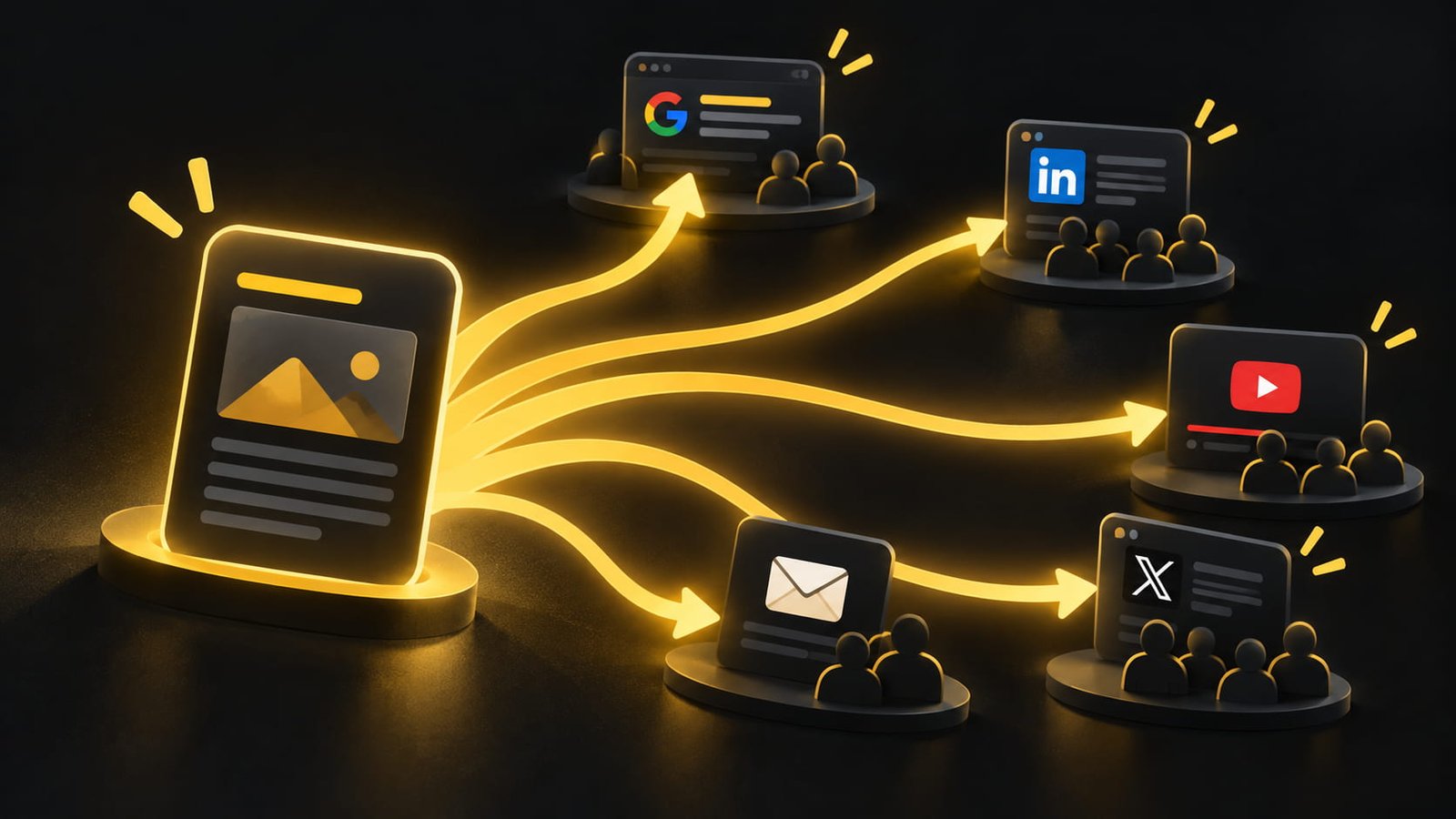
That plan can include search, email, social posts, partner newsletters, relevant communities, sales conversations, internal sharing and paid promotion. Not every article needs every channel. The right choice depends on the reader, the topic and the job of the piece.
For example, a practical glossary entry may get most of its lasting discovery through search and internal links. A current teardown may need to reach people while the campaign is still being discussed. A detailed guide may work well in an email to people who already trust the publication.
The useful question is not “Which platforms should we post on?” It is:
Where might the right reader already be, and what would make them notice this piece there?
That question also connects to compounding content. A durable article can keep attracting readers over time, but it still needs a first route into the world.
3 How do you choose where to distribute an article?
Start with the audience, not the platform.
If the article is for founders making a pricing decision, a targeted email, a founder community or a relevant sales conversation may be more useful than a general social post. If it answers a search question, make sure the page clearly answers that question and can be found by search engines. If it analyses a campaign that people are already talking about, a short, specific social post may help it enter that conversation.
Google’s SEO Starter Guide explains the basic work that helps search engines understand and discover a page. Search is one route to readers, not the whole distribution plan.
A useful content distribution strategy answers four questions:
- Who should read this first?
- Where are those people likely to encounter it?
- What version of the idea fits that channel?
- What would you like a reader to do after seeing it?
THE READER ROUTE
The Reader Route is the path from a useful piece of content to the first audience most likely to care about it.
Before publishing, write down:
Reader: Who is this for?
Reason: Why might they care now?
Place: Where might they find it?
Format: What form will make the idea easy to notice there?
Next step: What should an interested reader do after seeing it?
If any answer is missing, the article may be ready to publish, but its distribution plan is not.
4 The distribution work most teams skip
01. Choose the first readers. “Everyone interested in marketing” is not a distribution audience. Name the people most likely to understand the problem in the article. A piece about checkout pricing might start with ecommerce operators, not every marketer on every platform.
02. Give the article more than one entrance. A reader might arrive through search, an email, a social post, a colleague’s recommendation or a relevant community discussion. Each route needs a useful reason to visit. Do not rely on a single post to carry the whole piece.
03. Adapt the idea to the channel. A social post should give someone a reason to stop and read. An email can explain why the article is relevant to that reader. A short video can show one useful idea from the piece. The article remains the source, but its introduction changes.
04. Share the idea, not only the link. “New article out now” tells people that something exists. A specific observation, question or example gives them a reason to care. The post should deliver something useful on its own, then offer the article for more.
05. Make internal discovery easy. Link related articles together. A reader who finds one useful piece should have a natural path to the next one. Your article on search intent explains how a page can match the query. Distribution is how readers discover that page in the first place.
06. Give strong work more than one chance. Some readers will miss the first post. You can share a different idea from the same article later, send it to a relevant segment or update an older piece with a link to the new one. Repeat the idea with a new reason to notice it. Do not simply repost the same message every day.
07. Measure more than the first click. Look at relevant visits, time spent where available, return visits, signups, useful replies, saves, shares and whether the article helped readers take the next step. Google’s Search Console Performance report can help show the queries and search results that bring people to your pages.
5 A simple seven-day distribution plan
This is a starting plan, not a posting law. A topical Decode may need a shorter window. An evergreen guide can be distributed over months.
View
| When | What to do |
|---|---|
| Before publishing | Name the first reader and write two different ways to introduce the article. |
| Publish day | Share the most useful or surprising idea, with the article link for readers who want the full explanation. |
| The next day | Send it to the people who have opted to hear from you, if it is relevant to them. |
| Later that week | Share a different example, question or practical takeaway from the article. |
| After the first week | Check which route brought relevant readers and which question or detail earned a response. |
| When another article relates | Add a natural internal link so readers can move between the pieces. |
| Later on | Revisit the article if it remains useful. Update details and share it again with a new reason. |
6 The counter-weight
Distribution cannot rescue an article that does not deliver. If the page is vague, inaccurate or unhelpful, pushing it harder only sends more people to a disappointing experience.
Every platform is not the right platform. “We should post this everywhere” is not a strategy. It can waste time and make the brand feel repetitive.
A large audience is not always the right audience. A smaller group of people who care about the topic can be more useful than a broad reach with no connection to the article.
Search takes time and is not guaranteed. A well-structured article can still receive few impressions, especially on a new or little-known site. Check whether the page is indexed and whether it receives impressions before deciding that the writing itself failed.
Distribution has a cost. It takes time to adapt a piece, contact partners, write useful social posts and answer responses. Choose work that fits your team rather than adding a dozen channels to the checklist.
Internet Culture verdict desk
Publishing gets a page onto your site. Distribution gives it a chance to matter somewhere else.
7 Steal this
01. Before the next article goes live, name the first group of readers you want to reach. Be more specific than “marketers.”
02. Write three different introductions to the article: one for search, one for an owned audience and one for a social channel.
03. Pull out one idea that is useful on its own. Share that idea before asking people to click through.
04. Link the new article to two or three related pages on your site. Add links from older, relevant articles back to it.
05. Check Search Console for search impressions and queries. Check your other channels separately so you know which one brought the visit.
06. Revisit the article after a week. Decide whether to improve the page, change the way you introduce it or put it in front of a different group.
8 Frequently asked questions
What is a content distribution strategy?
A content distribution strategy is a plan for helping the intended audience discover and use a piece of content. It identifies the reader, the channels they may use, the format that fits each channel and the next step for an interested reader.
How do I promote an article after publishing it?
Share a useful idea from the article with a relevant audience, then give interested readers a route to the full piece. Use channels that suit the topic and the audience, such as search, email, social, partners or relevant communities.
Should I post the same article on every platform?
Not automatically. Different platforms create different expectations and attract different audiences. Adapt the introduction and format to the channel. If a platform is unlikely to help the intended reader find the article, you do not need to use it.
How often should I share an article?
There is no fixed number that works for every article. A timely piece may need a short, concentrated launch. An evergreen piece can be shared again when you have a new example, a useful update or a relevant audience.
How do I measure content distribution?
Measure whether relevant people found and used the content. Look at visits by source, search impressions, useful replies, return visits, signups and other outcomes that match the article’s purpose. A large number of impressions is not valuable if the intended readers never see the page.