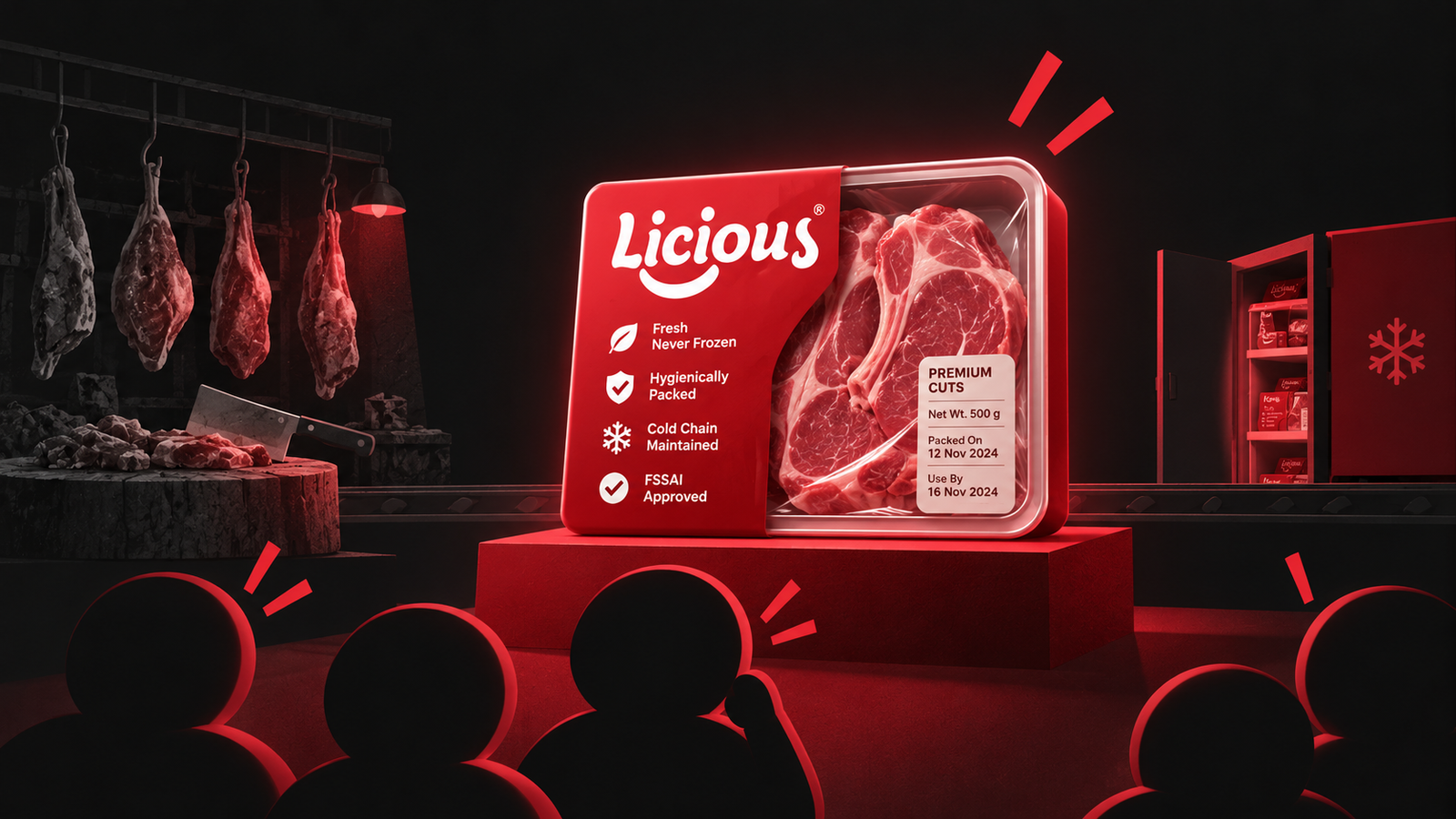
A vacuum-sealed box does not make meat fresher. What it does is far more valuable: it gives an Indian household a way to judge a quality it has no way of inspecting, and it quietly moves meat out of the wet market and into the grocery aisle of the mind.
Summary
Licious marketing strategy: Meat is a credence good, meaning buyers cannot verify hygiene or freshness even after consuming it. Licious solved this by replacing the butcher shop’s trust signals with manufactured sensory proxies: rigid tamper-evident packaging, vacuum sealing, cold handover, uniform cuts and printed dates. The packaging is not presentation. In an unverifiable category, packaging is the evidence.
Why this is worth eleven minutes
- Licious did not compete with butchers on meat. It competed with the anxiety of buying meat, which is a different and much larger market.
- When customers cannot verify quality, they do not stop judging. They switch to proxies. Whoever controls the proxies controls the category.
- Standardised cuts removed negotiation, and removing negotiation removed the household expert as a dependency. That single change opened the category to a generation of urban buyers who had never learned how to buy meat.
- The strategy required owning the supply chain end to end. The marketing claim dictated the capital structure, which is the correct order and almost nobody does it.
1 The scene
The traditional transaction: you stand at a shop. Carcasses hang. There is a sound. There is a smell. A man weighs something, adjusts, chops, and hands it to you in a thin translucent plastic bag that immediately goes warm and heavy in your palm. You walk home carrying it away from your body.
The Licious transaction: a rider hands you a rigid box. It is cold. It is sealed. It is dry on the outside. Inside, portions are vacuum-packed, uniform, dated. You put it in the fridge and forget about it.
The naive reading is that this is premiumisation. Nicer packaging, higher price, urban convenience. That reading explains the price and misses the mechanism entirely.
Licious did not improve the meat buying experience. It changed which question the customer was answering. The wet market asks: is this meat good? Licious asks: nothing. You never have to judge. That absence of judgement is the product.
2 What is a credence good, and why does it decide this category?
Economists sort products into three types based on how a buyer can assess quality.
Search goods. You can evaluate before buying. A shirt. A phone’s screen size.
Experience goods. You can only evaluate after using. A restaurant meal. A haircut.
Credence goods. You cannot reliably evaluate even after consuming. A dentist’s recommendation. A car repair. Organic certification. And meat hygiene.
This classification comes from Phillip Nelson’s work in 1970 and was extended by Michael Darby and Edi Karni in 1973, and it is the single most useful frame for understanding the Indian meat market.
You cannot see bacterial load. You cannot see how long the bird has been dead. You cannot see the temperature history between slaughter and your kitchen. You cannot see whether the cold chain broke on a Tuesday afternoon in May. Even after eating it and feeling fine, you have learned almost nothing, because the risk you care about is probabilistic and delayed.
Here is what follows from that, and it is the load-bearing insight of this teardown:
When buyers cannot verify quality, they do not stop judging. They transfer the judgement to whatever they can perceive.
The traditional meat trade knew this instinctively and built its entire trust architecture on perceivable proxies:
- The shop looks busy, therefore stock turns over fast, therefore it is fresh
- I know the butcher and my mother knew his father
- The meat looks red rather than dull
- He cut it in front of me
- The shop is not visibly dirty
None of these measure hygiene. All of them are correlated enough with hygiene to be rational. This is not superstition. It is efficient inference in the absence of information.
Licious’s actual innovation was to build a competing proxy stack and control every element of it.
3 The proxy substitution, item by item
Visualize
| The wet market’s proxy | What Licious replaced it with |
|---|---|
| I know this butcher personally | A brand with a name, an app, and a complaint channel |
| He cut it in front of me | Tamper-evident seal, so nobody cut it after |
| The shop looks busy | A printed packing date and time |
| It looks fresh | Vacuum sealing, which visibly prevents air contact |
| It is cold in the display case | A cold box that is still cold when it reaches your hand |
| I can ask him to cut it my way | Standardised named cuts, selected before ordering |
| My eye for a good piece | Uniform portions, so no piece is worse than another |
Read that table again as a strategy document rather than a packaging brief. Licious did not add packaging to meat. It systematically identified every trust signal the category ran on and engineered a manufactured substitute for each one.
That is the whole company.
THE TRUST PROXY STACK
In any category where the buyer cannot verify what they most care about, they will judge you on perceivable substitutes. The Trust Proxy Stack is the ordered set of those substitutes, and it is a design decision whether you make it or not.
Your customer is running this inference right now, on your product, using signals you did not choose.
The exercise: list the five things your buyer most cares about and cannot verify. Next to each, write the physical or digital signal they are actually using to judge it. Then ask which of those signals you control, and which you have left to chance.
Weight of the box. Load time of the page. Whether the invoice has a typo. Whether the rider’s bag is clean. Whether the seal is intact. Whether the number on the dashboard updates in real time. These are not details. In a credence category, these are the product.
4 The mechanism stack
01. Category exit through packaging vocabulary. A thin plastic bag places a product in the wet market category. A rigid, printed, sealed, refrigerated box places it in the packaged FMCG category. By adopting the visual grammar of packaged food, Licious moved meat into a different mental category. That matters because mental category determines the comparison set, and comparison set determines what counts as expensive. Against a butcher’s rate per kilo, Licious is costly. Against packaged paneer, cheese and ready-to-cook food, the same price is unremarkable. Positioning is choice of comparison set, and packaging is the fastest way to choose one.
02. Standardisation removes the expert. The wet market requires competence. You need to know cuts, know the going rate, know how to instruct, know when you are being handed the worse piece. That competence is usually held by one person in the household, often an older one. Every Indian nuclear urban household that lost access to that person also lost access to the category. Licious sells “chicken, curry cut, 500g, boneless” as a selectable item, and in doing so it removes the requirement for expertise. That is not convenience. That is category expansion, and it is why the buyer profile shifted so noticeably toward younger households and toward women who had not traditionally been the meat purchaser.
03. Negotiation removal as anxiety removal. Haggling is not just economically unpleasant. It is a continuous signal that you might be getting cheated, which in a credence category compounds directly onto the hygiene anxiety. A fixed price on a screen eliminates an entire channel of doubt. This is under-appreciated in Indian commerce generally: transparent pricing is a trust product, not a pricing product.
04. The sensory handover moment. Everything about the delivery is engineered around one instant: the two seconds when box meets hand. Cold, dry, rigid, sealed, no odour, no leak. That instant is where the brand promise is either validated or destroyed, and it happens before the customer has tasted anything. If the box is warm or wet, no amount of meat quality recovers it. If the box is cold and dry, the customer has already decided the meat is good.
05. The operating model came second, on purpose. You cannot vacuum seal a promise you do not control. To guarantee cold chain, packing date, cut consistency and temperature at handover, Licious had to own sourcing, processing, cold storage and last mile rather than operate as a marketplace on top of existing butchers. That is a capital-heavy, low-margin, operationally hostile choice. It was also forced by the marketing claim. The positioning dictated the balance sheet. Most companies do this backwards: they build the operation, then ask marketing to find something to say about it.
06. Repetition builds the habit the category never had. Meat purchase in India was traditionally episodic and occasion-linked. Sunday. Guests. Festivals. A fridge stocked with sealed, dated, portioned meat converts an occasion into an inventory, and inventory generates replenishment. Replenishment is the only reliable path to retention in food.
5 The counter-weight
The trust proxy is not the trust. This is the strongest criticism and it deserves to be stated bluntly. A vacuum seal proves nothing about bacterial load. A printed date proves nothing about the temperature history behind it. Licious replaced one set of unverifiable claims with a better-designed set of unverifiable claims. The customer’s epistemic position has not improved. Their confidence has. Whether those two things should be allowed to diverge this far is a legitimate question, and it applies equally to organic labels, cold-pressed claims and most of the wellness category.
The economics have been punishing. Publicly reported financials show Licious operating at substantial losses across multiple years, with revenue growth stalling in some periods even as losses narrowed. Owning the full stack means owning the cost of the full stack. Cold chain in Indian summer is not cheap, and shrinkage in perishables is unforgiving. A beautiful positioning does not automatically produce a beautiful P&L.
The proxy stack has been commoditised. FreshToHome, Zappfresh, Meatigo and others run comparable packaging logic. More significantly, quick commerce platforms now sell meat with the same visual signals, at lower prices, delivered in fifteen minutes. When every player in the category has adopted your differentiator, your differentiator has become the price of entry. Licious invented the standard and then had to compete against it.
Premium proxies cap your market. The stack is expensive to run, which forces a price premium, which structurally limits the addressable market to urban, higher-income households. The vast majority of Indian meat consumption remains in the unorganised trade, and it remains there largely on price. There is a real argument that Licious built an excellent product for a ceiling, not a floor.
The convenience may be doing more work than the trust. An honest sceptic would say the growth is explained by delivery, not by packaging psychology. Some of that is true. The counter is that convenience alone does not explain why people accept a significant price premium over a butcher who also delivers. Convenience gets the first order. The box gets the second one.
Internet Culture verdict desk
In categories where quality cannot be inspected, packaging is not presentation. It is evidence. And evidence is priced higher than product.
6 Where this transfers
The Trust Proxy Stack applies to any credence category, which is far more of the economy than most marketers assume.
- Diagnostics and healthcare. Nobody can evaluate a lab result. They evaluate the cleanliness of the collection, the punctuality of the phlebotomist, the design of the report.
- Supplements and nutrition. The active ingredient is unverifiable. The bottle, the seal, the certificate, the founder’s face on the label are all doing the work.
- B2B SaaS security. Nobody on the buying committee reads the architecture. They read the SOC 2 badge, the status page, the response time of the support email.
- Agencies and consultants. The buyer cannot evaluate the strategy before paying for it. They evaluate the deck’s typography, the speed of the first reply, whether the proposal has a typo.
- Used goods and refurbished electronics. The entire Cashify and Amazon Renewed model is a proxy stack: grading language, photographs, warranty, packaging.
- Home services. The uniform, the shoe cover, the branded toolkit. All proxies for competence nobody can assess in advance.
If you sell something a buyer cannot verify, you are not in the product business. You are in the evidence business.
7 Steal this from Licious marketing strategy
01. Write down the top three things your customer cares about and cannot verify before purchase. Then write down what they are judging instead. That second list is your real product specification.
02. Audit your handover moment. Find the single physical or digital instant where your promise is most visibly proved or broken. Packaging opening. First app screen. First email. First call. Spend disproportionately there, because that moment writes the customer’s opinion before the product gets a chance to.
03. Steal the category exit move. Look at the visual and verbal grammar of your current category. Then look at the category you would rather be compared against. Adopt its grammar deliberately: its packaging language, its pricing display, its terminology. You will be judged by a different comparison set within a quarter.
04. Remove the expertise requirement. Find every point where your customer needs prior knowledge to transact correctly. Sizing. Specification. Jargon. Choice of variant. Every one of those is a wall keeping out first-time buyers. Standardise and name the options so that a nervous beginner can choose without revealing that they are a beginner.
05. Remove the negotiation. Fixed, visible, unambiguous pricing is a trust feature in Indian commerce, and it is undervalued because it does not look like marketing.
06. Check whether your operating model can actually deliver your proxy. If your claim requires control you do not have, you will break it at scale and the break will be more expensive than the claim was worth. Licious built the supply chain because the box made a promise. If your box makes a promise, check who is keeping it.
8 FAQ
What is Licious’s business model?
Licious operates a full-stack direct-to-consumer model for fresh meat and seafood in India. Unlike a marketplace, it controls sourcing, processing, cold storage, packaging and last mile delivery. This vertical integration exists because its core promise, consistent freshness and hygiene, cannot be guaranteed without controlling every link in the chain.
Why is Licious more expensive than a local butcher?
The price difference reflects the cost of the trust infrastructure: owned cold chain, controlled processing facilities, vacuum packaging, temperature-controlled delivery and quality standardisation. Customers are not paying only for meat. They are paying for the removal of uncertainty about hygiene, freshness and cut quality.
What is a credence good in marketing?
A credence good is a product whose quality a buyer cannot reliably evaluate even after consumption. Examples include medical services, car repairs, organic produce and meat hygiene. In credence categories, buyers judge quality using perceivable proxies such as packaging, certification, presentation and brand signals, which makes those proxies commercially decisive.
How did Licious change consumer behaviour in the Indian meat market?
By standardising cuts, fixing prices and eliminating the need for category expertise, Licious made meat purchasable by households that lacked a traditional meat buyer. It also shifted meat from an occasion-based purchase at a butcher to a stocked grocery item, which changed purchase frequency and who in the household makes the decision.
Is packaging really a competitive advantage?
In credence categories, yes, but temporarily. Packaging functions as evidence where verification is impossible, and evidence commands a price premium. However, packaging is easily copied. Licious’s proxy stack has been widely replicated by competitors and quick commerce platforms, which converts an early advantage into a category standard.