Everyone remembers the invite-only gate and the celebrity ads. The mechanism that actually built the CRED marketing strategy was smaller and stranger: it manufactured a number young Indians could screenshot, and gave them a reason to believe the number said something true about them.
Summary
CRED’s early growth came from status, not rewards. By gating entry behind a credit score and surfacing that score as a clean, shareable artefact, CRED turned an invisible financial record into a public credential. Users posted it themselves. The rewards programme existed to create a monthly reason to open the app. The credit score gate existed to create a reason to want to.
Why this is worth eleven minutes
- CRED entered a category where the core job was already solved. Netbanking paid your credit card bill fine. That meant utility could not be the wedge, and CRED did not pretend otherwise.
- The credit score was not a feature. It was a proof object: an artefact the product manufactures so the user can make a public claim about themselves.
- Rejection was a product decision, not a scaling constraint. The people turned away were doing marketing work for free.
- Every exclusivity play contains its own expiry date, and most founders do not plan for it. CRED did, which is why the story is more interesting than the meme.
1. The scene
A new app appears with a rule that makes no commercial sense. You cannot join unless your credit score clears a bar. If it does not, you are told so, politely, and asked to come back later.
In a country where every fintech in existence was fighting to onboard anyone with a pulse and a PAN card, one app was sending people away.
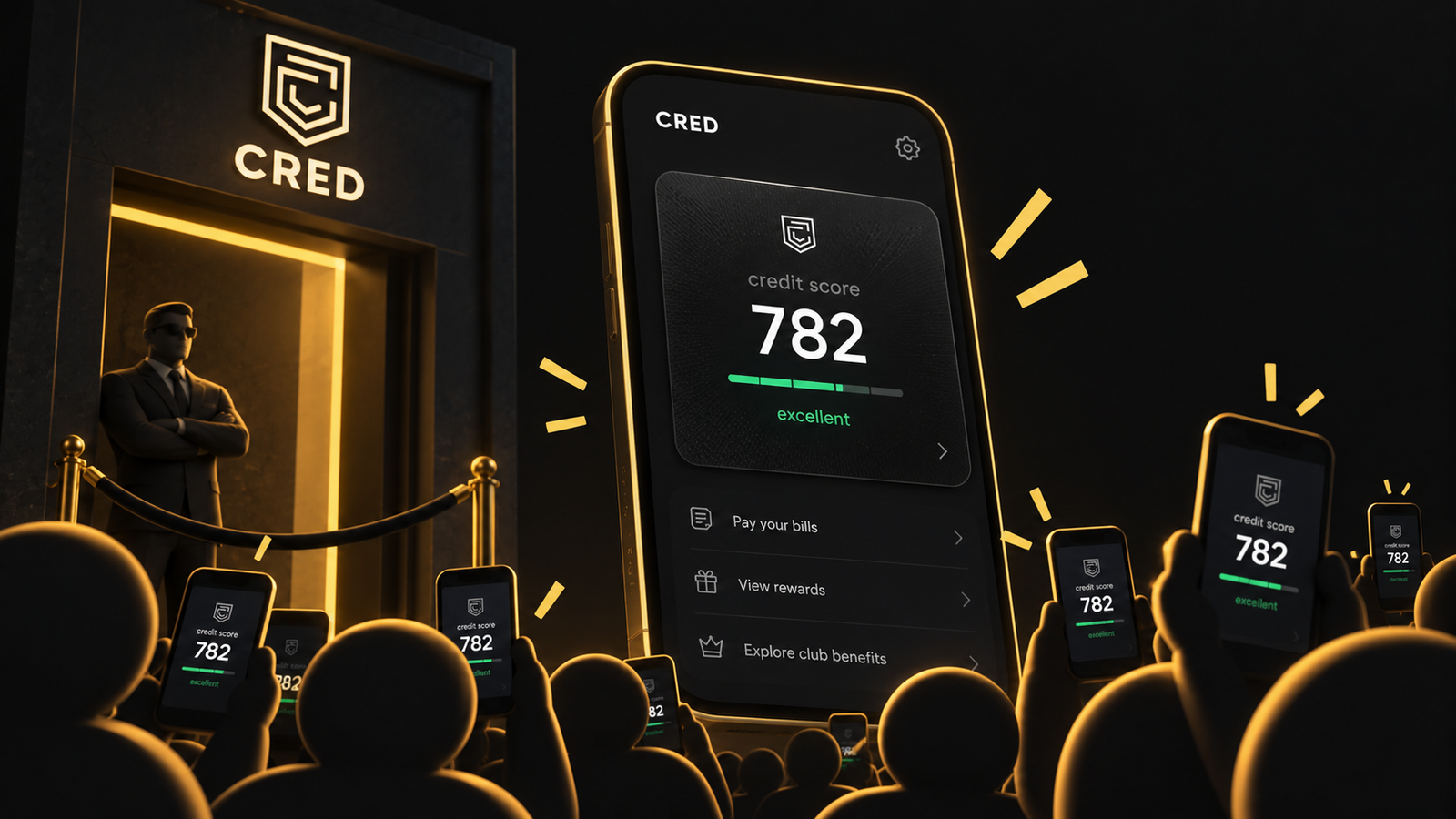
Within months, Indian tech Twitter and Instagram stories filled with a specific kind of screenshot. A dark interface. A large number. A short caption, or no caption at all.
Marketing commentary at the time landed on the obvious reading: clever invite-only launch, classic scarcity play, borrowed from Gmail and Clubhouse. That reading is right and shallow. Invite-only is a distribution tactic. What CRED built was a status instrument, and the difference between those two things is the difference between a launch stunt and a four-year growth engine.
2. What actually happened
CRED launched in 2018, founded by Kunal Shah after his exit from FreeCharge. The premise: pay your credit card bills through CRED and earn CRED coins, redeemable against a curated set of rewards and offers.
Entry was gated by credit score. The bar was set high enough that a meaningful share of Indian credit card holders did not clear it. The app’s tone was consistent with the gate. Dark, quiet, low-density, expensive-looking. The tagline that stuck was a statement of fact dressed as a shrug: not everyone gets it.
The advertising ran on the same logic. CRED sponsored the IPL. The campaigns did not explain the product. The Rahul Dravid “Indiranagar ka Gunda” film in 2021 became one of the most shared pieces of Indian advertising of the decade and contained almost no product information. The earlier series with Anil Kapoor, Madhuri Dixit, Govinda and Bappi Lahiri worked the same way: famous people being deliberately absurd, with CRED positioned as the thing only the audience in on the joke would understand.
Meanwhile the business model arrived late and in stages. Publicly reported financials through this period showed revenue in the tens of crores against losses in the hundreds, then revenue in the hundreds of crores against losses still larger. The revenue engine that eventually mattered, lending and financial products built on a pre-qualified high-creditworthiness base, was always the destination. The rewards app was the vehicle.
That gap between spend and revenue is the thing every critic pointed at. It is also the thing that makes the mechanism worth studying, because CRED was not buying customers. It was buying a member list with a specific property, and that property had a price.
3. Why did people screenshot their credit score?
Here is the question the marketing coverage never really answered.
A credit score is not an achievement in the way a marathon time is an achievement. It is a passive record of having paid bills on time. Nobody trained for it. Nobody chose it. Until 2018, almost nobody in India had looked at theirs, and the ones who had looked at it did so inside a bank portal that looked like a tax form.
Three things had to be true for that number to become postable.
It had to be invisible before. You cannot make a credential out of something everyone can already see. Credit scores existed. They were just buried in interfaces nobody visited. CRED did not create the number. It surfaced it, and surfacing something hidden is one of the cheapest ways to create value in a product.
It had to look expensive. A number rendered in a bank’s Arial table is data. The same number in a dark, spacious, deliberately premium interface is a badge. The visual treatment is not decoration here, it is the entire conversion from data to credential. Design did the work that copy could not.
It had to imply something about the person, not the account. This is the part people miss. A high credit score, for a twenty-seven year old software engineer in Bengaluru in 2018, was legible as a claim about character: I am responsible, I am solvent, I have my life together, I am the kind of person who pays things on time. Nobody had to write that claim down. The audience read it automatically, because the alternative interpretation, “this person has a bank record”, is boring and human beings do not post boring interpretations of themselves.
CRED did not build a rewards app. It built the first widely used status meter for financial adulthood in a country that had never had one.
THE PROOF OBJECT
A proof object is an artefact your product manufactures so a customer can make a public claim about themselves that would be socially awkward to say out loud.
Nobody posts “I am financially responsible”. Everybody posts a screenshot that says it for them.
Spotify Wrapped is a proof object for taste. A Strava run is a proof object for discipline. A Duolingo streak is a proof object for self-improvement. A credit score inside CRED was a proof object for competence.
The test that goes with it: if a user screenshots your product and posts it with no caption, what are they claiming about themselves? If the answer is “nothing”, you do not have a proof object. You have a dashboard.
4. The mechanism stack
01. The gate as a compliment. Most products treat rejection as failure. CRED treated it as messaging. Every person turned away learned two things: this club is real, and I am not in it yet. Rejection converts a product into a goal. It also creates the only reliable source of exclusivity, which is not scarcity of supply but scarcity of qualification.
02. Pre-qualified acquisition, disguised as brand. Underneath the status layer sat a coldly rational filter. A credit-score gate does not just select for status-conscious users. It selects for low-default, high-limit, high-spend customers, which is precisely the cohort a future lending business needs. CRED was running a credit underwriting filter at the top of the funnel and calling it an invite. That is one of the most elegant pieces of funnel design in Indian startup history and it was mostly discussed as a vibe.
03. Utility as retention chassis, not as value proposition. Credit card bills arrive monthly. That is a guaranteed recurring trigger with no marketing cost. CRED did not need bill payment to be better than netbanking. It needed bill payment to be a reason to open the app on a fixed schedule, so the status layer had a surface to sit on. Most brands do the opposite: they build strong utility and bolt a weak identity on top. CRED built strong identity and bolted the weakest possible utility underneath, because the utility only needed to recur.
04. Coins as a sunk cost you cannot cash out. CRED coins accumulate. They cannot be converted to money. Their only use is inside CRED. This is a switching cost built out of nothing, and it exploits the endowment effect: people value what they hold more than what they could hold. The coins were never the reason people joined. They were a reason people stayed.
05. Advertising that refused to explain. When you explain the product, you flatten it into a category. Explanation invites comparison. CRED’s advertising deliberately withheld explanation, which forced the viewer to resolve the ambiguity themselves, usually by downloading. Withholding information is a legitimate strategy when the product’s value is social rather than functional, because social value collapses the moment you describe it plainly.
06. Tone as a filter. The copy, the rejection emails, the interface density, the choice of fading nineties celebrities as comedy. All of it selected for a specific person: urban, young, English-first, internet-native, salaried, slightly ironic about status while being completely governed by it. CRED never had to define its ICP in a deck. The tone did the segmentation.
5. The counter-weight
Now the argument against, because this is the case study most often quoted by people who would not survive running it.
The economics were brutal and the critics were not wrong. CRED spent enormously to acquire users who generated almost no revenue for years. Publicly reported losses ran far ahead of income for multiple financial years. If you strip away the outcome and judge the strategy at the time, “spend hundreds of crores building a brand for a product with no revenue model” is not a template. It is a bet available only to founders with an exit behind them and investors willing to underwrite patience. Copying the tactics without the balance sheet has killed several Indian startups.
The status was rented from an external agency. The credential CRED surfaced was not CRED’s. It belonged to the credit bureaus. That makes it cheap to surface and impossible to defend. Within a few years, every fintech in India was showing users their credit score for free, and a credential available everywhere is no longer a credential.
The gate had to be widened, and widening it cost the mechanic. Growth and exclusivity are opposed forces. As the eligibility bar loosened and the base expanded into millions, “not everyone gets it” became demonstrably false. The brand kept the aesthetics of exclusivity long after the mathematics of it had gone. This is not a failure of execution. It is the structural fate of every exclusivity play, and the correct question is not how to avoid it but what you convert the status into before it fades.
The proof object aged badly. Posting your credit score in 2019 read as participation in a new cultural thing. Posting it in 2024 reads as an advertisement for an app. Proof objects have a novelty half-life. Spotify Wrapped survives because it refreshes annually with new content. A credit score does not refresh interestingly.
The imitators learned the wrong lesson. A generation of Indian startups took away “be exclusive” and “make premium dark-mode UI”. Several launched invite-only waitlists for products nobody was queuing for. Scarcity without an underlying qualification is theatre, and users can smell theatre in about nine seconds. What CRED had was a gate that meant something because a third party enforced it.
Internet Culture verdict desk
CRED did not sell rewards. It sold the receipt for a life well managed. Receipts are the most screenshotted objects on the internet, and people will pay for a well designed one.
6 The Gate Paradox, stated properly
The value of a gate is proportional to the number of people it keeps out. Growth reduces that number. Therefore every exclusivity-led product is engineered to destroy its own primary differentiator.
This is not a flaw to be fixed. It is a clock to be managed.
The strategic question for any brand built on access is: what are you converting the status into before the gate loses meaning? CRED’s answer was a pre-qualified, high-creditworthiness customer base for financial products. Clubhouse’s answer was nothing, which is why Clubhouse is a case study and CRED is a company.
7. Steal this
01. Find your proof object. Look at every number, score, streak, rank or summary your product already generates internally and ask which one a user would post. If none, ask which one you could surface that currently sits hidden in your database. Surfacing is cheaper than building.
02. Run the screenshot test on your own product this week. Take one screenshot of your core screen. Show it to five people. Ask them what the person who posted this is trying to say about themselves. If all five say “nothing”, you have an information display, not a status product.
03. Gate on qualification, not on supply. Waitlists gate on supply and everyone knows the supply is fake. Gating on a third-party verified attribute, a credit score, a domain email, a portfolio, a verified role, produces exclusivity that the user cannot argue with and you did not have to manufacture.
04. Separate your retention trigger from your value proposition. Your value can be emotional. Your trigger must be calendrical. Find the recurring event in your customer’s life that already happens on a schedule and attach yourself to it. Bill dates. Salary dates. Renewal dates. Monday mornings.
05. Write the rejection. Whatever your gate is, the message to the people who fail it is a piece of marketing collateral, and it will be screenshotted more than your homepage. Most companies let a developer write it.
06. Name the conversion before you build the gate. Write one sentence: when exclusivity stops working, this audience becomes valuable because ______. If the blank is empty, you are building a party, not a business.
8. FAQ
What was CRED’s original business model?
CRED launched in 2018 without a clear revenue model. Users paid credit card bills through the app and earned CRED coins redeemable against offers. Revenue came later through financial products including lending, merchant partnerships and commerce, built on top of a user base pre-filtered for high creditworthiness.
Why was CRED invite-only with a credit score requirement?
The credit score gate served two purposes simultaneously. It created exclusivity and social proof, which drove organic word of mouth. It also pre-qualified users for creditworthiness, which meant the eventual lending business inherited a low-risk customer base without additional acquisition cost.
What is status marketing and how did CRED use it?
Status marketing sells social standing rather than functional utility. CRED used it by surfacing a user’s credit score as a visually premium, shareable artefact, turning an invisible financial record into a public signal of responsibility and solvency. Users distributed the brand themselves by sharing screenshots.
Did CRED’s advertising actually work?
CRED’s IPL campaigns generated very high recall and cultural penetration, particularly the 2021 Rahul Dravid film. Whether that translated efficiently into revenue is contested, because CRED’s reported losses substantially exceeded revenue for several years. The advertising unquestionably built brand salience. Its return on investment is a separate and unresolved question.
Can a small startup copy CRED’s exclusivity strategy?
The mechanic is copyable, the capital is not. Small teams can apply the underlying principles: gate on a third-party verified attribute rather than fake scarcity, surface a hidden metric as a proof object, and attach retention to a recurring calendar event. What is not copyable is spending for years without a revenue model.