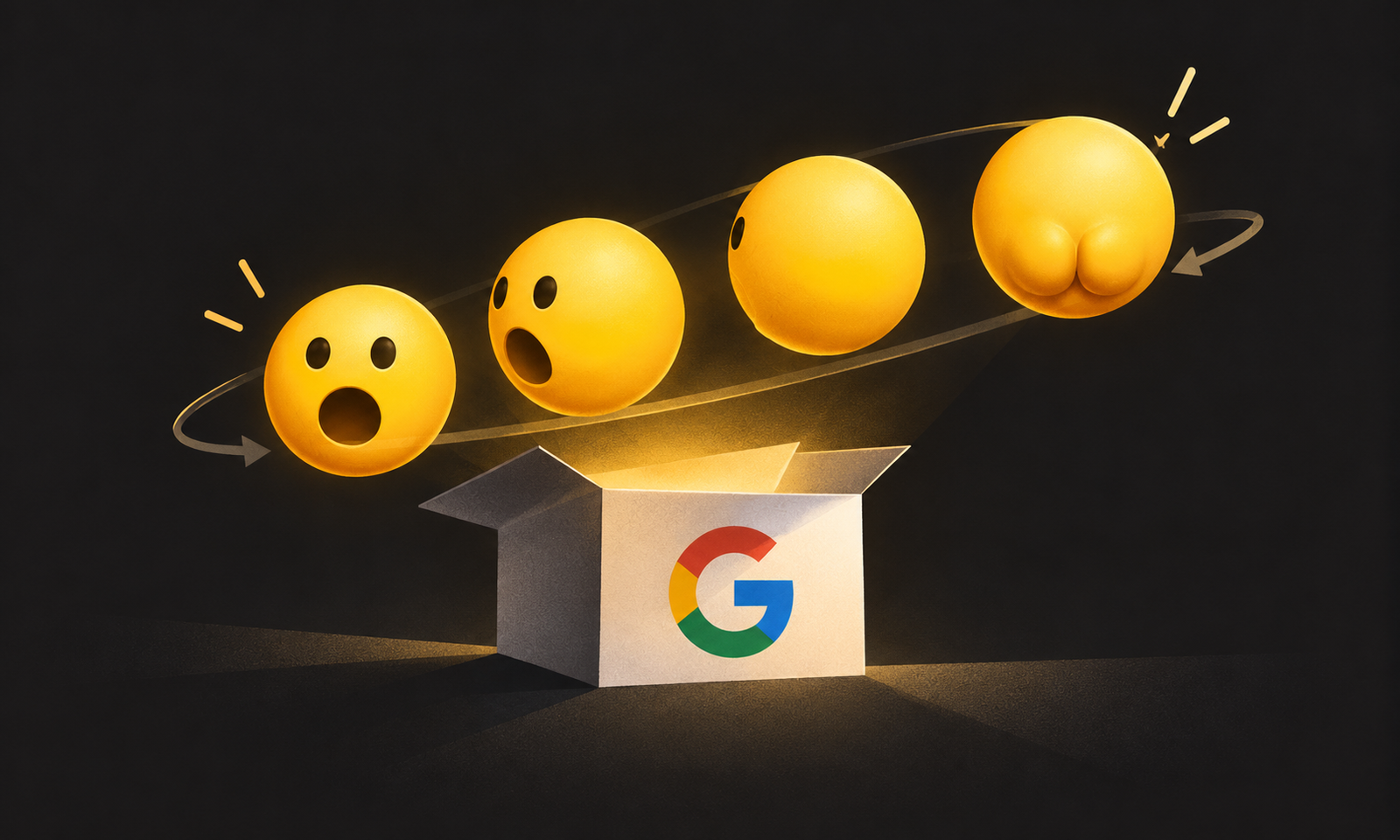
Make a familiar emoji three-dimensional and people will ask the obvious question: what does it look like from behind?
Google knew the joke was coming. Instead of posting a dry explanation and waiting for the replies, it put the joke in its own announcement. A routine design update got a line people wanted to share.
Summary
Google 3D emoji announcement made the predictable joke about seeing every angle before other people could make it the story. That gave audiences an easy way to join the conversation and made the update more shareable. The humour could soften the reaction to a design change, but it could not prove that users liked the new emoji.
Internet Culture · Decode 008 · Teardown by the desk
The verdict card
| Dimension | Score | Why |
|---|---|---|
| Strategic coherence | 9/10 | The launch anticipated the reaction people were likely to have. |
| Craft | 9/10 | One line, one wink, no long explanation. |
| Risk | 7/10 | Self-aware humour can feel forced, especially from a large company. |
| Replicability | 8/10 | Useful for a low-stakes change people are likely to joke about. Not a fix for a bad decision. |
Verdicts are opinionated by design. Disagree loudly.
Why this is worth ten minutes
- People notice changes to things they use every day, even when the change is small.
- Google 3D emoji shows how a brand can predict a harmless joke and invite people to join it.
- The joke made the announcement worth sharing. That does not mean everyone welcomed the redesign.
- The same move can help with a rebrand or product update, but it should never be used to laugh away a problem that hurts customers.
1 The scene
You open your phone and your favourite emoji look different. They are rounder. Shinier. They have depth now.
The first reactions to a redesign are usually predictable. “Bring back the old ones.” “Why does this look like a toy?” And when a familiar face becomes a three-dimensional object: “What does the back look like?”
Google’s announcement included the joke before the replies could make it the whole story:
“Once we started imagining the 360-degree view of our assets, we started confronting questions Unicode never warned us about: What does the back of a smiley face look like? Just kidding! Butt, IMAGINE!”
That line did not explain why the design changed. It did something different. It showed that Google knew what people were likely to say, and it gave them a joke they could pass along.
The risk with that move is obvious too. A funny announcement can make a design change easier to talk about. It cannot make a design change better.
2 What changed in Google’s 3D emoji project?
According to the details supplied for this article, Google’s Noto 3D emoji work covers 3,977 characters, with the models made available as .OBJ files. The rollout is described as beginning with Pixel devices before reaching other Google products.
Those details need a direct link to Google’s original design post before publication. The post itself is also where readers should be able to check the exact wording of the joke.
The number of emoji and the file format help explain the scale of the work. They are not the reason the announcement travelled. Most readers are not going to share a post because it mentions .OBJ files. They are more likely to share it because they recognise the joke and enjoy seeing Google make it first.
That distinction is the point of this teardown. The product update was the news. The line was the invitation to join in.
3 Why did the joke help the announcement travel?
Because it answered the reaction people were already preparing to have.
A familiar design has a head start in memory. People have seen it, used it and attached small meanings to it. A change asks them to update that memory. Some will enjoy the new look. Others will miss the old one. And some will make a joke before they decide what they think.
Google did not wait for the joke to arrive from the outside. It made one itself, lightly and once. That gave people a choice: they could repeat the line, add their own version or keep talking about the design.
This is a small but useful lesson in brand communication. A launch is not only the information a company sends. It is also the conversation people have around it.
We have made a similar point in our piece on when rebrands reset brand memory. Familiar visual cues do real work. When they change, people notice, even if they cannot explain exactly what feels different.
OWN THE JOKE
Own the Joke is a launch move: predict the harmless joke people will make about a change, then make it yourself once, lightly.
It works best when the change is small, the joke is obvious and nobody is being hurt.
Rule 1. Predict the first reaction. Ask what people will say in the first few minutes, before the brand has explained anything.
Rule 2. Make the joke once. One clear line is enough. Explaining it or repeating it makes the humour feel like a campaign.
Rule 3. Know what not to joke about. A design change may be fair game. A price increase, service failure or privacy problem needs a straight answer.
4 The mechanism stack
01. Google reached the joke before the comments did. The line worked because the audience could see it coming. The announcement did not need to explain why the joke was funny. People completed it themselves.
02. Humour gave the update a second reason to travel. A product update is useful news for people who care about emoji design. A funny line is easy to send to someone who may not care about the update at all. The post had a conversation attached to it.
03. Self-awareness lowered the distance between company and audience. A polished design announcement can make a large company feel stiff. A short, relevant joke can make the people behind the work feel more present. The humour does not make Google small. It makes the announcement less formal.
04. The joke matched the subject. Emoji are playful. A playful line belongs beside them. This is where brand humour often goes wrong. The joke may be funny on its own but still feel out of place for the product or the moment.
05. The humour acknowledged a real detail. Three-dimensional objects have a back. The line came from a genuine design question, rather than from an attempt to bolt internet slang onto an ordinary announcement. That is why it felt more natural.
Google’s earlier emoji changes also show how familiar design can become. People can miss an old visual style even if they never thought of it as an important part of the product. That is one reason a rebrand can cost more recognition than the design team expects.
5 The counter-weight
A joke does not fix a design people dislike. It may buy the update a warmer introduction. If users still find the new emoji worse, the joke will not change their daily experience.
A large company can sound like it is trying too hard. Internet humour changes quickly. A brand that borrows slang without understanding it can sound like it is performing relatability. Google’s line worked because it was short and connected directly to the design question.
The joke is only safe while the stakes are low. If a change affects people’s money, privacy, safety or access, a wink can sound dismissive. People need a clear answer before they need a laugh.
Self-deprecation cannot replace accountability. Making fun of a harmless design choice is different from joking about an error that caused real harm. If customers are dealing with a problem, the brand should fix it and explain what happened.
A shareable post is not proof of acceptance. The joke can travel farther than the design itself. Likes and shares tell you that people reacted to the post. They do not, by themselves, tell you whether users prefer the new emoji.
Internet Culture verdict desk
The joke did not make the new emoji impossible to criticise. It made the first conversation about them a little more fun.
6 Steal this
01. Before a visible launch, ask the team what people will joke about first. Write down the obvious answer, not the clever one.
02. Check whether the joke is harmless. If it touches money, privacy, safety, access or a real customer problem, do not use it to soften the announcement.
03. Write one line in the brand’s natural voice. If the joke needs a paragraph of explanation, it is probably not the right joke.
04. Ask someone outside the marketing team to read it. If the line sounds like a brand trying to act like a person, cut it.
05. Keep the announcement clear. Explain what changed, where it appears and what customers need to do. The joke can sit beside that information, not replace it.
06. Judge the product and the post separately. Measure whether people shared the announcement, then check whether they actually use or prefer the new design.
7 Frequently asked questions
What is Google’s 3D emoji project?
The project described in the supplied brief turns Google’s Noto emoji designs into three-dimensional models. The brief says the work covers 3,977 characters, with models released as .OBJ files and an initial rollout to Pixel devices. Confirm these details against Google’s original post before publishing.
Why did Google make a joke about the back of its 3D emoji?
The joke anticipated the obvious question people might ask when familiar emoji became three-dimensional. It gave readers a short, amusing line to share and showed that Google understood the conversation around the design change.
Why do people react to emoji redesigns?
People use emoji often and attach familiar expressions or meanings to particular designs. Changing a design can make a familiar message feel slightly different. Some people welcome that change. Others prefer the version they already know.
What does “own the joke” mean in marketing?
It means identifying a harmless joke people are likely to make about a change, then making that joke yourself once and lightly. The approach can set a playful tone, but it should not be used to avoid answering a serious customer concern.
Can humour make customers accept a redesign?
Humour can make a redesign more approachable and give people a reason to discuss it. It cannot show that customers like the design or make them keep using it. Measure the reaction to the announcement separately from people’s response to the product.