Everyone assumed Zepto was burning investor money on billboards. Then you notice something odd. The billboards are thick in some neighbourhoods and completely missing in others. That pattern is the whole story.
Summary
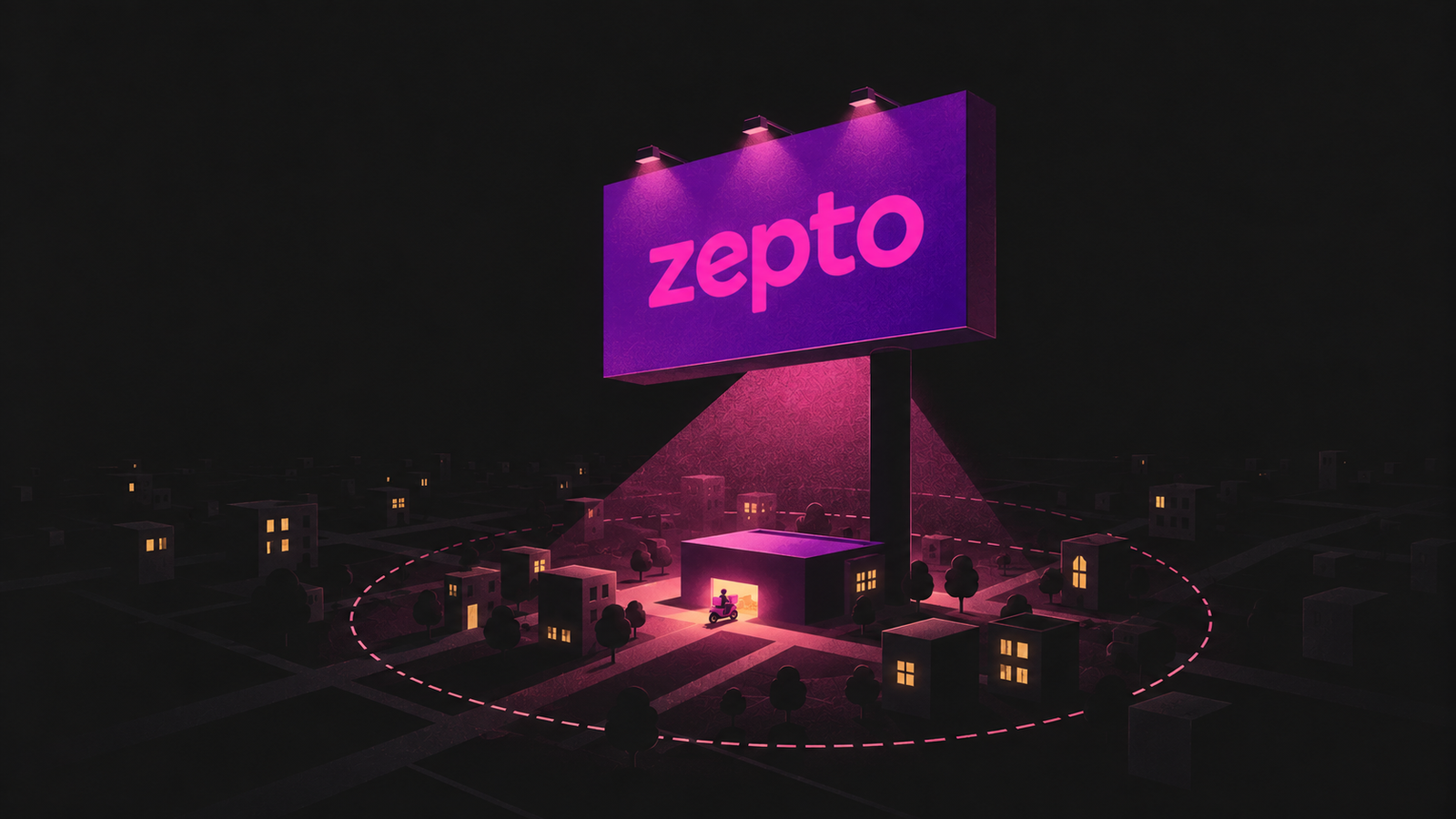
Zepto marketing strategy uses billboards as a local acquisition tool, not just for brand building. Zepto delivers from small dark stores that each serve a radius of roughly 2 to 3 km. A billboard only reaches people who live, work or drive past that spot, which makes it a precise way to fill a store’s delivery zone. Digital ads reach people everywhere, including people Zepto can’t deliver to.
Internet Culture · Decode 005
Why this is worth ten minutes
- Most people judge billboards as brand spend. For a delivery business, they can behave like targeted ads.
- The Zepto marketing strategy only makes sense once you understand how a dark store makes money.
- The lesson works for any business with a delivery area, a service radius or a physical store. That covers a lot of Indian businesses.
1 The scene
You’re stuck at a signal in Bengaluru or Mumbai. You look up. Zepto. Next signal, Zepto again. Then a bus stop. Zepto.
Marketing Twitter has an easy verdict: a funded startup lighting money on fire so everyone knows its name.
For most billboard campaigns, that verdict is fair. Billboards are hard to track and easy to waste.
But drive to a part of town where Zepto doesn’t deliver. The billboards thin out. That’s not a coincidence. That’s the plan.
2 How does the Zepto business model actually work?
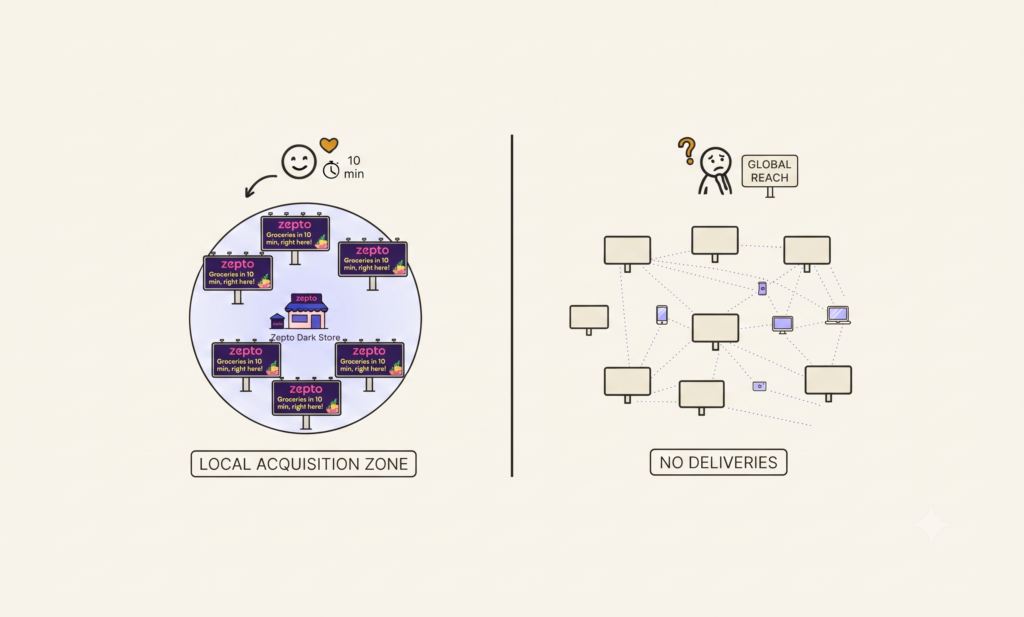
To understand the Zepto marketing strategy, start with how Zepto delivers.
Zepto doesn’t ship from one giant warehouse. It runs many small warehouses called dark stores. They look like shops, but customers never walk in. Each one is packed with the few thousand items people order most, like milk, bread, snacks and cleaning supplies.
Each dark store serves a small circle around it, usually 2 to 3 km. That short distance is what makes a 10 minute delivery possible.
Here’s the part that matters for marketing. A dark store has fixed costs: rent, staff, electricity, stock. It only makes money when enough people inside its circle order often enough. A customer 15 km away is useless to that store, no matter how much they love the brand.
So the real marketing job isn’t “get more customers in India.” It’s “fill this 3 km circle, then the next one, then the next one.”
3 Why billboards fit quick commerce marketing so well
Now compare two ways to reach people.
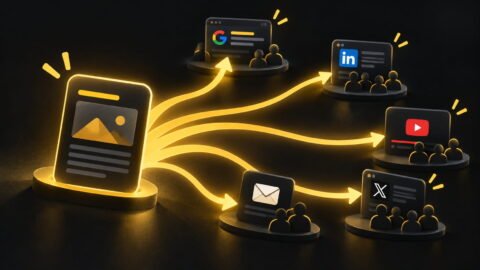
Instagram and Google ads reach people based on interests and behaviour. You can target by location, but ad targeting is fuzzy at the neighbourhood level. Some of your money always reaches people outside your delivery zone.
A billboard reaches exactly the people who pass that spot. Every day. It can’t be skipped, blocked or scrolled past. If the billboard sits inside a dark store’s circle, almost everyone who sees it can actually order.
That flips the usual thinking. For most brands, OOH advertising in India is broad and hard to aim. For a business built on small delivery circles, it’s one of the most precisely aimed tools available.
THE DELIVERY ZONE RULE
Never spend money where you can’t keep your promise.
Rule 1. Draw your zone first. Before choosing any channel, mark the area where your product or service actually works well. For Zepto, that’s the 10 minute radius.
Rule 2. Judge channels by how well they hit the zone. A cheap ad that reaches people you can’t serve isn’t cheap. It’s waste.
Rule 3. A billboard outside your zone is a donation. It builds awareness for a promise you can’t keep there. Worse, it might send those people to a rival who can.
4 The mechanism stack
01. Familiarity makes the first order easier. The hardest order in quick commerce is the first one. People already have a grocery habit. Seeing the same logo on the way to work every day makes the app feel familiar before they’ve even downloaded it. When the milk runs out at 9 PM, Zepto is the name already in their head.
02. After the first order, habit takes over. Groceries are bought again and again. Once someone orders milk and eggs a few times, the habit does the selling. So the billboard’s job is small but important: get that first order. The repeat orders don’t need billboards.
03. The promise gets more true over time. As Zepto opens more dark stores in a city, deliveries get faster in those areas. The billboards say “10 minutes”, and in the neighbourhoods seeing them, that promise gets easier to keep. Not many ads get more honest as time goes on.
04. The creative is built for a traffic signal. One big promise. One strong colour. One logo. You have about three seconds at a red light. In a category where the product is speed, a fast, simple billboard fits the product.
05. Billboards help the rest of the plan. People who see a billboard often search the brand name later. That makes Zepto’s search ads and app store listings work better. The billboard warms people up. Other channels close the sale.
5 The counter-weight
Nobody can prove exactly how well it works. Billboard results are hard to measure. Smart teams use tests, like comparing neighbourhoods with and without billboards, and watch changes in app installs and brand searches. Those tests give a direction, not an exact number. Anyone quoting precise billboard ROI is guessing.
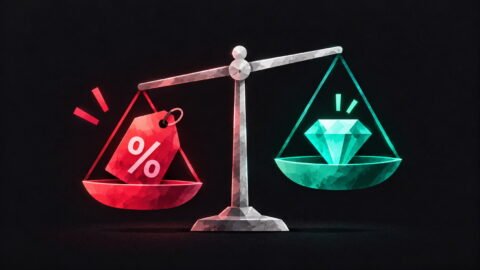
The money came from funding, not profit. Quick commerce in India has been heavily funded by investors. Critics fairly point out that a lot of marketing, discounts included, ran on raised capital. Until the full numbers are public, any claim that the billboards “paid for themselves” should be treated with care.
Every rival says the same thing. Blinkit, Swiggy Instamart and Zepto all promise speed. When three brands make one promise with similar-looking ads, there’s a risk you build interest in fast delivery in general, and a rival’s discount wins the order.
It only works in dense cities. This logic needs lots of people packed into small areas. In smaller towns with spread-out homes, the same plan would work far less well.
Internet Culture verdict desk
For a delivery business, “brand spend” and “performance spend” are the same money. The only thing that matters is whether the person seeing the ad can actually get the order.
6 Steal this
01. Draw your delivery zone or service area on a map. Keep it honest. Where can you really deliver fast and well?
02. Check where your ad money actually lands. Look at the location reports in Meta and Google. How much reached people outside your zone?
03. Tighten your ad location targeting to match your zone. It often costs less and converts better.
04. Write your promise in one line. If it can’t be read in three seconds, it won’t work on a billboard, a flyer or a phone screen.
05. Try one small local test. A flyer drop, an auto-rickshaw ad, or a sign near your store in one area. Compare orders from that area against a similar area without it.
06. Watch brand searches after any offline push. If people start searching your name more in that area, the offline ad is doing its job.
7 Frequently asked questions
What is Zepto’s marketing strategy?
Zepto marketing strategy combines billboards, digital ads and referral offers, with a strong focus on the neighbourhoods its dark stores serve. Billboards are placed heavily in dense city areas where Zepto can deliver in about 10 minutes, so most people who see them can actually order.
How does the Zepto business model work?
The Zepto business model runs on dark stores, small warehouses that stock popular everyday items and serve customers within roughly 2 to 3 km. The short distance makes fast delivery possible. Each store needs enough regular orders from its own area to cover rent, staff and delivery costs.
Why does Zepto spend so much on billboards?
Because billboards only reach people in a specific location. For a business that can only deliver within small zones, that makes billboards a well-aimed way to win first-time customers near each dark store, rather than just a general brand-building expense.
Do billboards work for startups?
Billboards can work for startups whose customers are concentrated in a known area, such as delivery apps, local services or physical stores. They work less well for businesses that sell everywhere online, because much of the audience may never become customers.
How do you measure billboard advertising results?
Compare areas with billboards against similar areas without them, and track changes in brand searches, app installs, website visits and orders from those areas. This shows whether the billboard is helping, even if it can’t give a perfectly exact return.