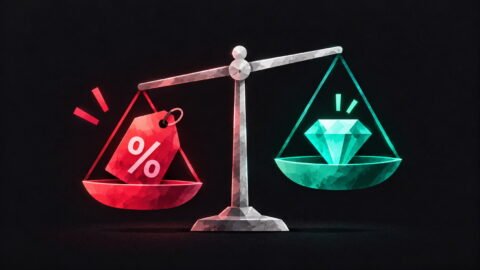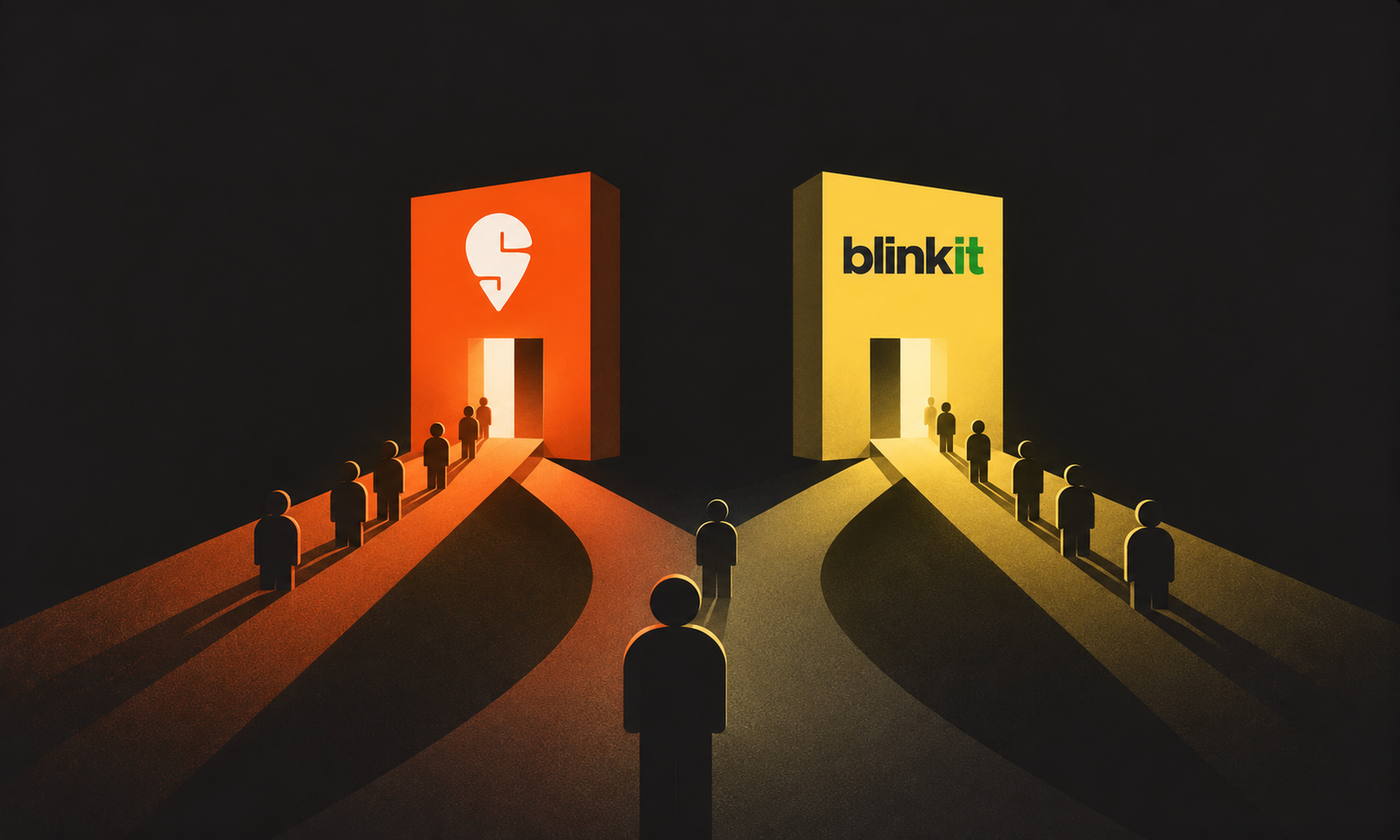
Every comparison article asks the same questions. Which one is faster? Which one is cheaper? Which one has more products? Those questions assume people compare before every order. Most people don’t. They reach for the same app every time, without thinking. Winning that reflex is the real fight.
Summary
Swiggy Instamart vs Blinkit is usually framed as a race on speed and price, but both deliver in roughly the same time from similar dark stores. The real competition is to become the app people open first, without comparing. Quick commerce in India rewards habit, because orders are small, frequent and urgent. Whoever owns the first tap wins most of the orders.
Internet Culture · Decode 009 · Teardown by the desk
The verdict card
| Dimension | Score | Why |
|---|---|---|
| Strategic coherence | 8/10 | Both companies are chasing frequency, which is the right goal in this category. |
| Craft | 7/10 | The apps look more alike every quarter. Hard to tell apart without the logo. |
| Risk | 5/10 | Heavy discounting and thin margins. Habits bought with offers can be bought back. |
| Replicability for you | 8/10 | The idea of winning the first tap works in almost any repeat-purchase business. |
Verdicts are opinionated by design. Disagree loudly.
Why this is worth ten minutes
- The usual Swiggy Instamart vs Blinkit comparison misses the point. The products are now close enough that small differences rarely decide orders.
- In frequent, low-value purchases, the first app opened usually wins. Habit beats features.
- The same lesson applies to D2C, subscriptions and any business that sells something people buy again and again.
1 The scene
The milk runs out at 9:40 PM. You need it for tomorrow morning.
You don’t open two apps and compare. You don’t check which one is ₹3 cheaper. Your thumb goes to one icon, the way it always does. You order. It arrives. You forget about it.
Now multiply that by millions of people and hundreds of small moments a month. Bread. Chips. A phone charger. Coriander. Each moment is too small to bother comparing.
That’s why the Swiggy Instamart vs Blinkit fight looks different from the inside. It isn’t won one order at a time. It’s won one habit at a time.
2 How do Swiggy Instamart vs Blinkit actually compare?
On the surface, the two services are now very similar.
| Index | Blinkit | Swiggy Instamart |
|---|---|---|
| Parent | Eternal (formerly Zomato Ltd) | Swiggy |
| Model | Dark stores close to customers | Dark stores close to customers |
| Promise | Delivery in minutes | Delivery in minutes |
| Range | Groceries plus expanding categories like electronics, beauty and home | Groceries plus expanding categories |
| Where you find it | Its own app | Inside the Swiggy app, and as its own app |
Check the latest details on each company’s site before publishing, since apps and categories change often.
Both run the same basic Blinkit business model, often called the dark store model. Small warehouses stocked with popular items sit close to where people live. Riders pick up and deliver quickly. Speed depends on how many stores are nearby, not on the brand.

So when two services offer similar speed, similar products and similar prices, what decides which one you use?
3 Why does habit beat price and speed in quick commerce?
Three features of quick commerce in India make habit unusually powerful.
The orders are small. Saving ₹5 on a ₹150 order isn’t worth opening a second app. When the stakes are small, people don’t compare. They default.
The orders are urgent. You order because you need something now. Urgency kills research. The first app that comes to mind gets the order.
The orders are frequent. Groceries are bought weekly, sometimes daily. Every repeat order makes the habit stronger. After a few months, the choice isn’t a choice anymore.
Put those together and you get a market where the most valuable thing isn’t a lower price. It’s being the icon your thumb finds without asking your brain.
THE FIRST TAP RULE
In small, frequent, urgent purchases, people don’t compare. They default. The business that becomes the default wins most of the orders, even when it isn’t the cheapest.
Rule 1. Win the first few orders, whatever it takes. Habits form early. The first five orders matter more than the next fifty.
Rule 2. Show up in every small moment. The more reasons a customer has to open you, the stronger the habit gets.
Rule 3. Never give them a reason to look elsewhere. A missing item or a late delivery sends customers to the other app, and that’s how habits break.
4 The mechanism stack
01. Category expansion is habit expansion. When quick commerce apps add electronics, beauty, toys and gifts, it’s not just about bigger baskets. Every new category is a new moment to open the app. More moments, more taps, stronger habit.
02. Having its own app is a habit decision. Blinkit has always had its own app, so its icon sits on your home screen and means one thing. For a long time, Instamart lived mostly inside the Swiggy food app, where it shared space with food delivery. That’s why a separate Instamart app matters. A habit needs its own icon.
03. Out of stock is the habit killer. Nothing breaks a default faster than “item unavailable”. When the thing you need is missing, you open the other app. Do that a few times and the other app becomes the new default. Stock depth matters as much as speed.
04. Memberships lock the habit in. Paid memberships that offer free delivery or extra perks give customers a reason not to switch. Once you’ve paid for one, using another feels like wasting money.
05. Discounts start habits but can’t hold them. Big first-order offers win trial. But customers who come only for discounts often leave for the next discount. The goal is to turn a discounted first order into an undiscounted fifth one.
5 The counter-weight
Many people use both. Plenty of customers keep both apps and switch depending on offers or what’s in stock. For these users, habit is weaker and price matters more. The habit story is strongest for busy, less price-sensitive customers.
The economics are still tough. Quick commerce has been heavily funded, and both companies have spent big on dark stores, delivery and discounts. Winning the habit only matters if the habit eventually becomes profitable.
Dark store density matters more than branding. In areas where one service has more stores nearby, it will usually be faster and better stocked. In those areas, operations decide the winner, not marketing.
Zepto is in the same race. This isn’t a two-player game. A third strong player means discounting pressure stays high and loyalty stays harder to hold.
Local shops still matter. Kirana stores still serve a huge share of Indian grocery shopping. Quick commerce is winning urban convenience moments, not all grocery shopping.
Internet Culture verdict desk
In quick commerce, nobody wins by being slightly cheaper. They win by being the app your thumb opens before your brain gets involved.
6 Steal this
01. Find your customer’s “small moment”. When do they need you without thinking about it?
02. Make the first five purchases as easy and pleasant as possible. That’s when habits form.
03. Count how many reasons a customer has to come back each month. Add one more.
04. Track repeat rate by month, not just total orders. Habit shows up in repeat behaviour.
05. Fix the things that make people look elsewhere: stock-outs, delays, surprise fees.
06. If you use discounts, plan the step off them. Know which order should be the first one at full price.
7 Frequently asked questions
What is the difference between Swiggy Instamart vs Blinkit?
Swiggy Instamart is Swiggy’s quick commerce service, and Blinkit belongs to Eternal, formerly Zomato Ltd. Both use dark stores to deliver groceries and everyday items in minutes. The main differences come down to local store density, product range, offers and how each app is used.
Which is better, Swiggy Instamart or Blinkit?
It usually depends on your area. The service with more dark stores near you tends to be faster and better stocked. Prices and offers change often, so many customers try both and settle on whichever works best locally.
How does the Blinkit business model work?
Blinkit runs small dark stores close to customers, stocked with popular products. Riders pick up orders from these stores and deliver them quickly. The model depends on enough frequent orders in each store’s area to cover rent, staff and delivery costs.
Why is habit so important in quick commerce?
Quick commerce orders are small, urgent and frequent, so people rarely compare apps before ordering. They open whichever app they’re used to. That makes becoming the default app more valuable than being slightly cheaper.
Who is winning the quick commerce race in India?
Market positions change quickly, and public estimates vary. Blinkit, Swiggy Instamart and Zepto are the main players in many large cities. Check recent company results and trusted business news for the latest picture.