Customer acquisition cost does not rise because you got worse at a channel. It rises because the channel worked, other people noticed, and the price of attention climbed to meet the value of it. Growth is not about finding the right channel. It is about noticing when the window is closing while you still have time to build something that outlives it.
Summary
Every acquisition channel follows the same arc. An early arbitrage window offers attention priced below its value, competitors enter, customer acquisition cost rises, performance degrades, and the channel settles into an efficient market where returns match effort. The arc is driven by competition and platform economics, not by execution quality. Durable growth comes from using arbitrage windows to fund owned assets that do not reprice.
Internet Culture · Playbook · Growth 002
Helps you decide: which channel to enter, when to leave, and what to build with the money while it is still cheap.
Why this is worth eleven minutes
- Rising customer acquisition cost is usually diagnosed as a creative problem or an agency problem. It is most often a market structure problem, and no amount of better creative fixes market structure.
- Every channel has an arbitrage window, and windows close for structural reasons that are visible in advance if you know what to look for.
- The only real defence is to convert rented attention into owned assets while the rent is low, which almost nobody does because the channel is working and nobody wants to interrupt it.
1 The room
A growth lead is explaining why customer acquisition cost is up sixty percent year on year. The deck blames creative fatigue, privacy changes, a new competitor and a seasonal dip.
All four are true. None is the cause.
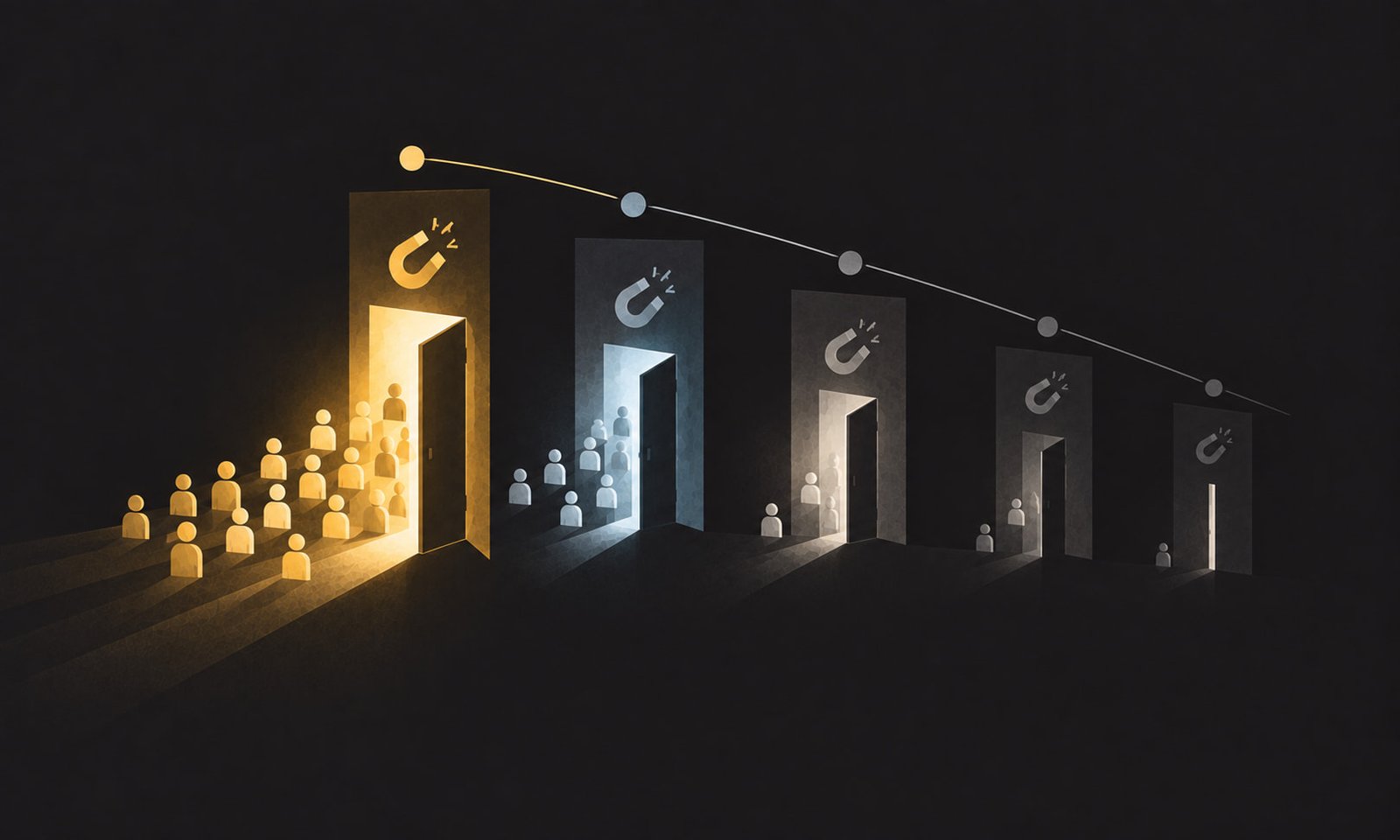
The cause is that the channel worked, and the market found out. Between 2015 and 2018 an Indian direct-to-consumer brand could buy attention on Meta at prices that had almost no relationship to what that attention was worth. That gap was not a skill. It was a window. Thousands of brands walked through it. The window closed in the ordinary way: by being profitable in public.
2 Why does customer acquisition cost always rise over time?
Three forces, and they operate on every channel ever created.
Competition bids up the price. Any auction-based channel prices attention by demand. Success attracts entrants. Entrants raise bids. Price rises until the marginal advertiser earns roughly nothing. This is not a bug in Meta or Google. It is what an auction does.
Platforms harvest the surplus. Organic reach on every major platform has followed the same path: generous at launch to attract supply, then steadily reduced as the platform monetises. Facebook Pages, Instagram organic, LinkedIn, YouTube. The platform gives away distribution until you depend on it, then charges for it. Anyone building on rented land is subject to the landlord’s business model.
Audience defences rise. Cold email deliverability worsens as inboxes get smarter. Banner blindness. Ad skipping. Notification fatigue. The first thousand brands to try something benefit from novelty. The ten thousandth is training an antibody.
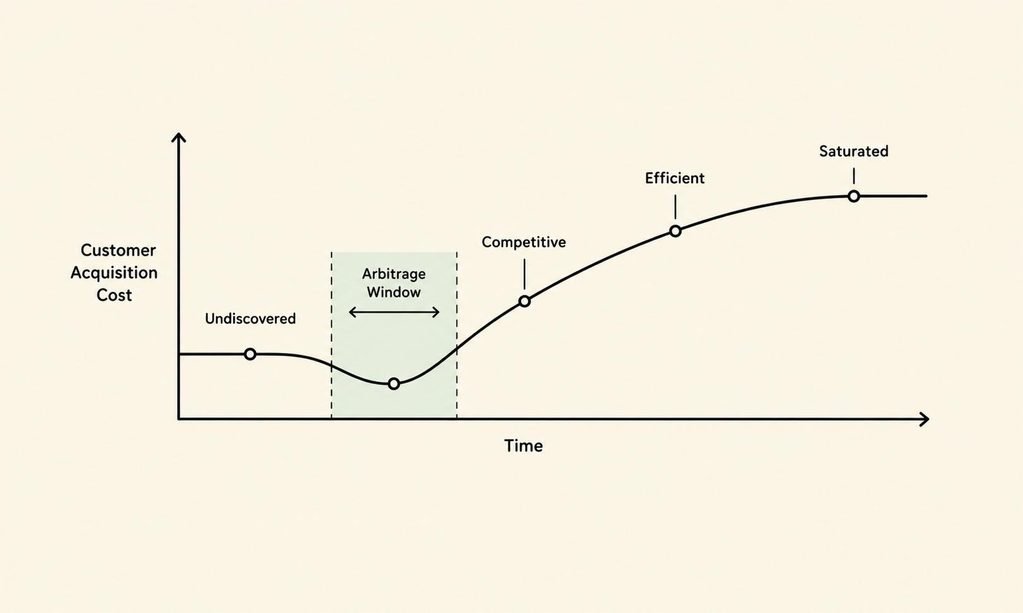
Put together, every channel produces the same curve and the same customer acquisition cost trajectory.
| Phase | What it feels like | What to do |
|---|---|---|
| Undiscovered | Nobody is here, feels like a waste of time | Test cheaply, be early |
| Arbitrage | Absurd returns, feels like a secret | Scale hard, and fund asset building |
| Competitive | Returns normalise, craft starts to matter | Optimise, hold position |
| Efficient | Returns match effort, everyone has agencies | Maintain, stop expecting growth |
| Saturated | Negative returns for late entrants | Exit or accept it as a cost of presence |
The strategic error is almost never picking the wrong channel. It is misjudging which phase you entered at.
THE ARBITRAGE WINDOW
A channel is worth entering when attention is priced below its value, and it stops being worth entering the moment that gap closes. The gap always closes.
Three signals tell you the window is shutting, and all three are visible before the numbers turn:
Agencies start selling it. When a service category exists for a channel, the arbitrage is already in the price.
The platform launches an ads product for it. The platform monetises exactly when organic demand exceeds supply.
Your competitors’ creative starts looking like yours. Convergence means everyone has found the same format, and format advantage is gone.
The rule: the arbitrage window is not the growth strategy. The arbitrage window is the funding event for the growth strategy. What you build with the money is the actual business.
3 What should you build before customer acquisition cost catches up?
The distinction that matters is between rented attention and owned assets.
Rented attention stops the moment you stop paying. Paid media. Influencer posts. Sponsorships.
Owned assets keep producing after the spend ends. An email list. A community with its own reason to gather. A content library that ranks and gets cited. Distinctive brand assets that make future media cheaper. A product loop. A physical distribution presence.
The transfer is the entire game. Most companies with a great paid channel never build owned assets, because the paid channel is working and building assets does not show up in this quarter. Then the channel reprices, and they discover they own nothing.
A useful discipline: assign a fixed percentage of every arbitrage window’s profit to asset construction, and treat it as non-negotiable. Not a budget line that gets cut when performance dips. A tax on the window.
4 The mechanism stack
01. Channel market fit is a real thing and it is narrower than product market fit. A channel must fit your business model, your price point and your product. A ₹499 product cannot survive a channel with a ₹900 customer acquisition cost, no matter how good the channel is. Channels are not universally good or bad. They are compatible or incompatible with a specific unit economics profile.
02. Early entry is worth more than good execution later. The advantage of arriving in an arbitrage phase is structural, not skill-based. A mediocre operator in phase two outperforms an excellent operator in phase four. This is uncomfortable and it is consistently observable.
03. New formats reopen old channels. A saturated channel can partially reopen when the platform ships a new format, because the new inventory is under-priced until demand catches up. Reels at launch. Every new ad placement. Windows are not only found in new channels.
04. Small budgets have a real advantage here. Arbitrage windows are usually too small to matter to large advertisers, which is exactly why they stay cheap. A brand spending two lakh a month can profitably live in channels a brand spending two crore cannot be bothered with.
05. Marketing channel saturation is category-specific, not channel-specific. A channel can be saturated for direct-to-consumer fashion and virtually empty for industrial business-to-business. Diagnose your own category’s competitive density, not the general discourse.
5 The counter-weight
Chasing windows is a real failure mode. Teams that permanently hunt for the next arbitrage never build depth anywhere, and depth is what produces the creative and operational advantage that carries you through phase three. Constant channel switching is as damaging as channel loyalty.
Efficient does not mean useless. A channel in the efficient phase still delivers customers at a price. It just stops being a source of growth advantage. Search ads on your own brand terms are entirely rational and will never make you grow.
Not every rise in customer acquisition cost is structural. Sometimes it really is creative fatigue, a tracking break or a landing page regression. Diagnose before you philosophise. The test is whether competitors in your category are experiencing the same move.
Owned assets are not free. An email list needs content. A community needs moderation and a reason to exist. Search visibility needs continuous work, and the ground under search is itself moving. Owned is cheaper than rented. It is not costless.
Internet Culture verdict desk
Every channel is a window, not a home. The question is never how long it will stay open. It is what you carried through it before it shut.
6 Steal this
01. Place each of your channels on the five-phase curve this week. Be honest about which phase you entered at, not which phase you wish you were in.
02. Compute the trend, not the number. Plot customer acquisition cost by channel monthly for twenty four months. Direction matters more than the current value, and the slope tells you how much runway the channel has left.
03. Set an asset tax. A fixed share of profit from your best-performing channel goes to building something that does not reprice. Decide the percentage now, while the channel is working, because you will not decide it later.
04. Keep a permanent test budget. Five to ten percent, always running, always in channels that look like a waste of time. Most will be. The one that is not pays for all of them.
05. Watch the three closing signals. Agencies appearing, platform ad products launching, competitor creative converging. Each is a signal to start the transfer, not to panic.
7 Frequently asked questions
Why does customer acquisition cost keep rising?
Customer acquisition cost rises primarily because auction-based channels price attention by demand, and success attracts competitors who bid prices up. Platforms also reduce organic reach over time to monetise attention, and audiences develop resistance to formats they have seen repeatedly. These forces are structural and affect every advertiser in a category simultaneously.
What is channel market fit?
Channel market fit is the compatibility between an acquisition channel and a business model, specifically whether the channel’s typical customer acquisition cost can be supported by the product’s price point, margin and repeat purchase behaviour. A channel that works for a high-priced product with strong retention may be unusable for a low-priced one.
How do I know when to leave a marketing channel?
Look for three signals before the numbers turn: agencies begin selling the channel as a service, the platform launches a paid product for it, and competitor creative starts converging on the same formats. Combined with a rising customer acquisition cost trend over several months, these indicate the arbitrage window is closing.
What is the difference between owned and rented marketing channels?
Rented channels such as paid media and influencer partnerships stop producing the moment spending stops. Owned assets such as email lists, communities, content libraries and distinctive brand assets continue producing after the initial investment. Sustainable growth usually involves converting profit from rented channels into owned assets.
How do you reduce customer acquisition cost without cutting spend?
Improve the economics rather than the bid. Raise average order value, improve retention so each customer is worth more, build owned assets that deliver customers at zero marginal cost, and find under-priced inventory such as new ad formats or emerging channels before competitors arrive.