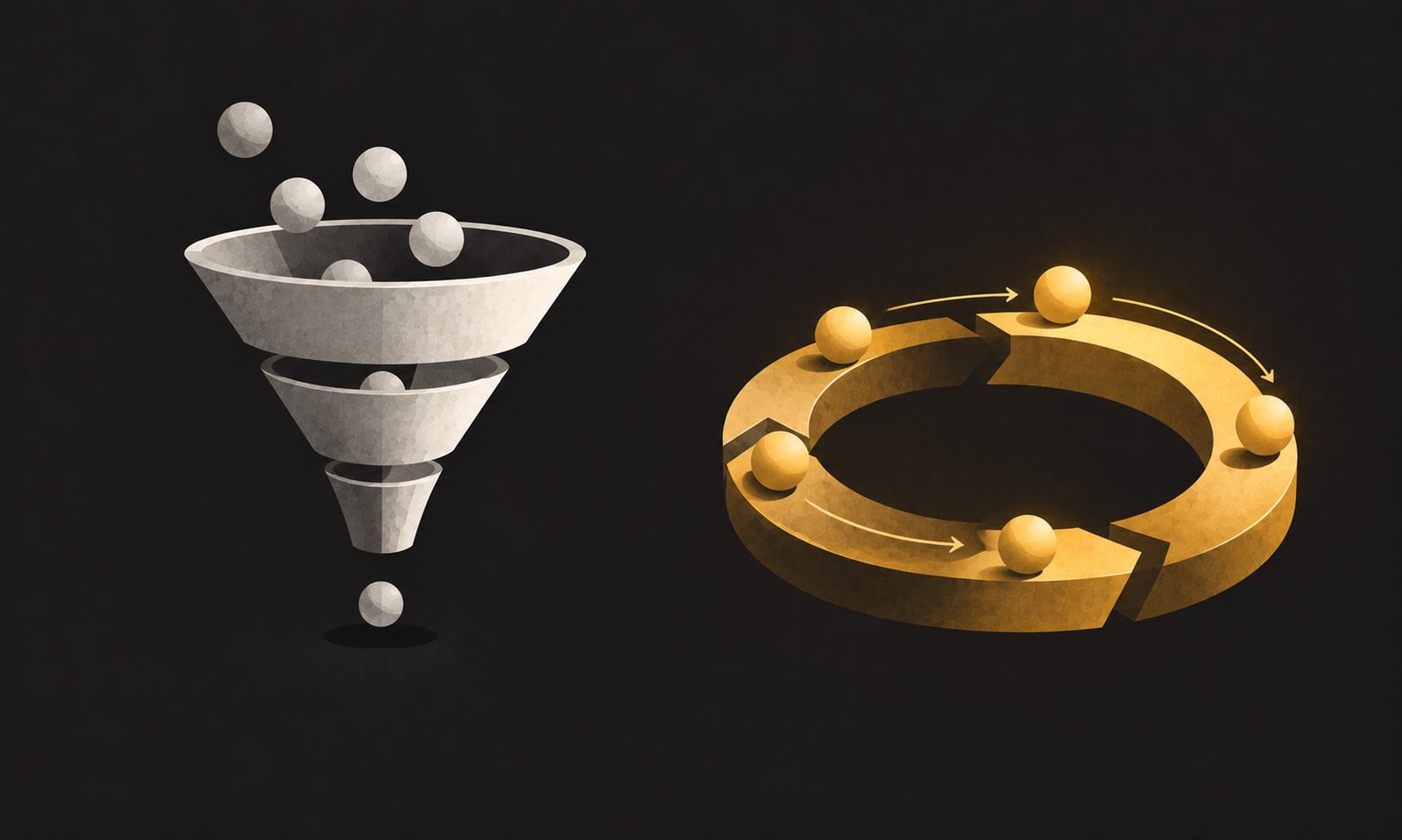
A funnel is a report. Growth loops are a machine. The difference between them is one question: does the output of this system feed the input, or does the input have to be bought again next month?
Summary
Growth Loops: A funnel is a linear description of customers moving from awareness to purchase, and it must be refilled with new spend every cycle. Growth loops are closed systems where the output of one cycle becomes the input of the next, so each cycle makes the following one cheaper. Loops compound and funnels do not. A loop only functions if users retain, which makes retention the precondition for growth rather than a stage inside it.
.
Internet Culture · Playbook · Growth 001
Helps you decide: whether your growth is compounding or being rented, and what to build if it is being rented.
Why this is worth eleven minutes
- A funnel is a measurement model that got mistaken for a growth strategy, and the mistake costs companies their entire marketing budget every single month.
- Growth loops have four common types. Most companies could run one and instead run none, because loops require product work and funnels only require budget.
- Retention is not a stage. It is the condition under which any loop is even possible, and a loop built on a leaking product accelerates the leak.
1 The room
Monday review. The chart shows leads at the top, demos in the middle, closed deals at the bottom. Conversion rates between each step. Everyone discusses which rate to improve.
Nobody asks the only question that determines whether this business gets easier or harder over time: what does a closed deal produce that brings the next one in?
If the answer is nothing, then next month begins at zero, and it will begin at zero every month until the company dies or somebody changes the model. The funnel is not wrong. It is a photograph of one month’s traffic, and photographs do not grow.
2 What is the difference between growth loops and a funnel?
A funnel runs in one direction. Spend goes in the top, customers come out the bottom, and the system stops. Every cycle needs fresh fuel from outside.
Growth loops close. The output of the cycle becomes an input to the next cycle, without new spend.
The cleanest way to tell them apart is to ask what a new user produces.
| Model | What a new user produces | What happens if you stop spending |
|---|---|---|
| Funnel | Revenue | Growth stops immediately |
| Growth loop | Revenue and a new input | Growth slows and continues |
The distinction was popularised by operators including Brian Balfour, Casey Winters and Andrew Chen, and it is the most useful reframing in growth since cohort analysis, because it moves the strategic question from “which channel” to “what does our product produce that attracts the next user”.
3 The four types of growth loops
01. Viral loops. A user brings another user directly. Dropbox’s storage-for-referrals is the canonical case, and invite-only fintech onboarding is the Indian one. A viral loop is measured by K factor: invites sent, multiplied by the conversion rate of those invites. A K factor below one is still enormously valuable, because it multiplies everything else you buy.
02. Content loops. Users create content, the content gets found, the finders become users. Pinterest and Quora ran this at scale. Every marketplace with public listings runs it whether they know it or not, which is why Airbnb’s listing pages became a search asset larger than its ad budget.
03. Paid loops. Revenue from cohort one funds acquisition of cohort two. This is a genuine loop, but only when payback is fast enough to recycle capital inside the same operating period. A twenty six month payback is not a loop. It is a bet on the next funding round.
04. Product-led loops. Usage of the product exposes it to non-users. Calendly’s booking links. Loom’s shared videos. A payment gateway’s checkout appearing on thousands of merchant sites. The product travels because using it requires showing it to someone else.
The best businesses run more than one, and the growth loops feed each other.
THE REINVESTMENT TEST
For every new customer, write down exactly what gets produced that helps acquire the next one.
Not revenue. Revenue is an output, not an input. An input is a public page, a shared link, a referral, a review, a piece of content, a verified data point, a network connection that makes the product better for the next person.
If the box is empty, you do not have a growth system. You have a purchasing habit.
The three failure states:
The loop exists but is invisible to the user, so it never fires.
The loop exists but retention is too low for it to complete a cycle.
The loop exists and produces something nobody wants, which is most referral programmes.
4 Why does retention decide whether growth loops can exist at all?
Here is the part that gets skipped.
Every loop requires the user to survive long enough to produce the next input. A referral happens after value is experienced. A content contribution happens after habit forms. A renewal funds the next cohort only if the renewal happens.
Which means retention is not the third letter in an acronym. It is the gate.
Plot a cohort retention curve and look at the shape.
Decays to zero. No loop is possible. Users are leaving before they produce anything. Spending on acquisition here is not growth, it is an expensive way to measure churn.
Decays then flattens. A real product exists. The height of the flat portion is your genuine base, and that base is the population your loop can run on.
Smiles. Users leave, then return in increasing numbers. Rare, and usually indicates network effects switching on. If you have this, you are under-investing.
The operating rule that follows is blunt: do not scale paid acquisition until the retention curve flattens. Before flattening, every rupee of spend is subsidising an exit.
5 The counter-weight
Not every good business has growth loops, and that is allowed. Enterprise software with twelve buyers in the country, high-consideration insurance, industrial equipment. These grow through sales effort and relationships. Trying to force a viral loop onto them produces embarrassing referral programmes and nothing else.
Loops are slower and harder than campaigns. A loop is product work. It requires engineering, design and often a change to the core experience. A campaign requires a budget approval. This is the actual reason most companies run funnels: growth loops need a team that marketing does not control.
Loops saturate. Every loop has a ceiling, usually the size of the network it can reach. Dropbox’s referral loop slowed once most of the addressable market had a Dropbox-using friend. Loop design is not a one-time act. It is maintenance.
Paid loops get called loops when they are not. If your payback is longer than your funding runway, calling it a loop is a rhetorical trick that makes a cash flow problem sound like a growth strategy.
The funnel is still a good diagnostic. This is not an argument to abandon it. Funnels tell you where conversion is leaking. Growth loops tell you whether the system compounds. You need both, for different questions.
Internet Culture verdict desk
A funnel tells you how efficiently you spent last month’s money. A loop tells you whether you will need to spend it again.
6 Steal this
01. Run the Reinvestment Test on your current business this week. One sentence. If the box is empty, that is the most important finding you will have this quarter.
02. Check the curve before you check the channel. Plot weekly cohort retention for the last six months. If it has not flattened, pause the scaling conversation entirely.
03. Find the loop you already have and cannot see. Almost every business produces something that attracts strangers: customer reviews, public profiles, shared documents, branded outputs, physical packaging in public. Most of it is unoptimised because nobody owns it.
04. Instrument the loop as a metric, not a campaign. K factor, content pages indexed per active user, shares per session, payback period. If it is not on the weekly review, it is not a system.
05. Reduce the number of steps before the loop fires. Every one of your growth loops has a moment where the user must do something. The gap between activation and that moment is where most loops die.
7 Frequently asked questions
What are growth loops?
Growth loops are systems where the output of one growth cycle becomes the input of the next, so each cycle makes the following one cheaper. The four common types are viral loops, content loops, paid loops funded by revenue, and product-led loops where usage exposes the product to new users.
What is the difference between a funnel and a growth loop?
A funnel is linear and must be refilled with new spend each cycle, while growth loops are closed and reinvest their own output. A funnel describes how users convert, a loop describes how growth sustains itself. Funnels are useful for diagnosing conversion problems and poor at explaining compounding.
Why is retention important for growth loops?
Every loop requires users to stay long enough to produce the next input, whether that is a referral, a piece of content or a renewal. If the retention curve does not flatten, users leave before completing a cycle, and no loop can function regardless of how well it is designed.
What is a K factor and what is a good number?
K factor is the number of new users each existing user generates, calculated as invites sent multiplied by the conversion rate of those invites. A K factor above one produces self-sustaining exponential growth and is extremely rare. A K factor between zero point two and zero point five is commercially significant because it multiplies every other acquisition channel.
Can a business-to-business company build growth loops?
Yes, but usually content loops and product-led loops rather than viral ones. Public case studies, shared documents, embedded widgets, integrations and referral from professional networks all function as loops. Businesses with very small buyer universes often cannot run loops at all and should not pretend otherwise.