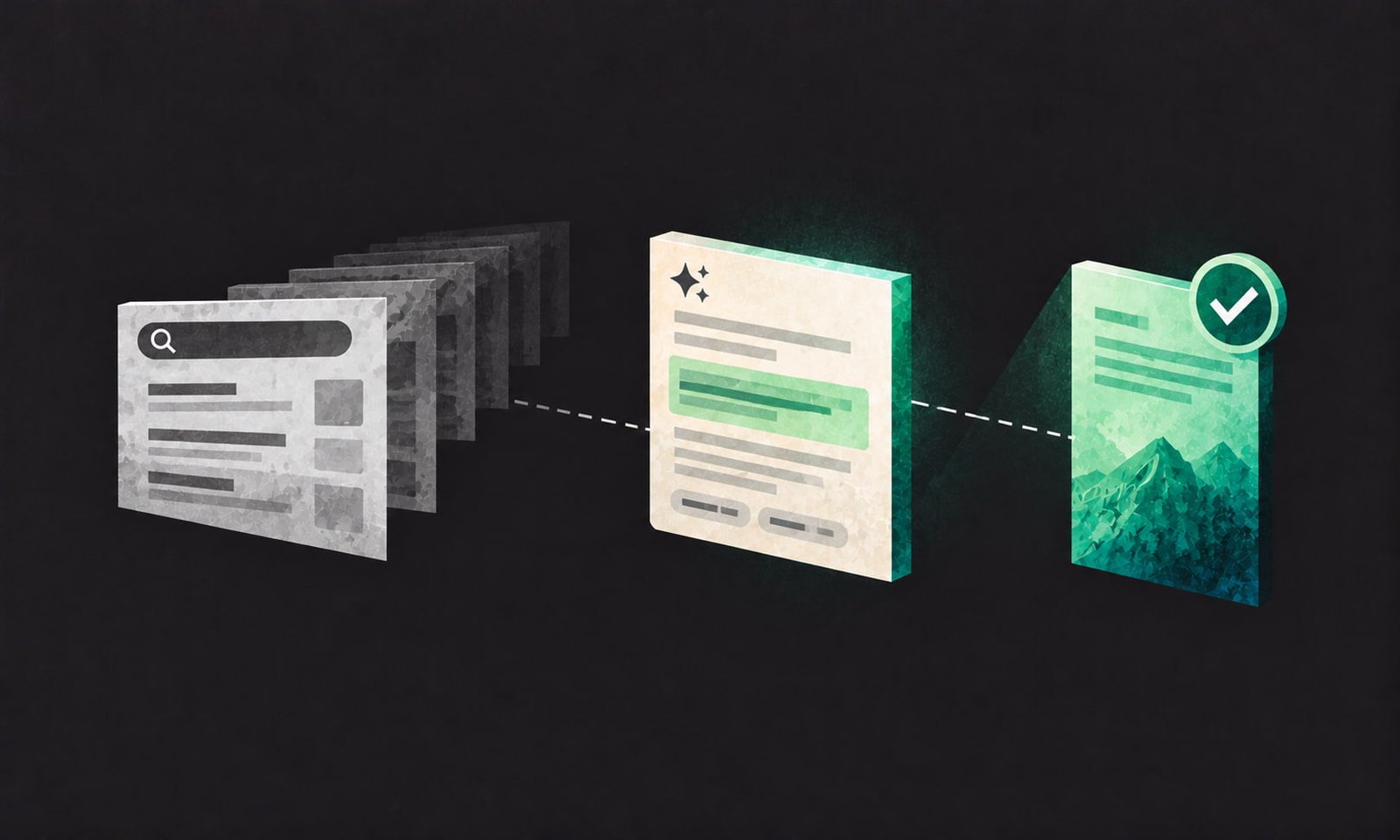
The click is disappearing and the citation is replacing it. That is not the end of content marketing. It is a change in what content is for, and answer engine optimisation is the name of the new job. The brands that understand the difference will be quoted inside the answer while everyone else argues about rankings.
Summary
Answer engine optimisation is the practice of structuring content so AI systems retrieve and cite it. AI Overviews and chat assistants increasingly resolve queries on the results page, which reduces clicks for informational searches. Content strategy therefore shifts from winning the click to being the source inside the answer. This requires self-contained passages, direct answers near the top, verifiable claims and original material.
Internet Culture · Playbook · Content 001
Helps you decide: what to publish, how to structure it, and what to stop measuring.
Why this is worth eleven minutes
- Traffic and influence have decoupled. A page can shape a purchase decision without ever being visited, and your analytics will record that as a failure.
- Answer engines cite differently to how search engines rank. They lift passages, not pages, which changes how you write paragraphs and why answer engine optimisation is a craft problem before it is a technical one.
- The single biggest advantage available in AI search right now is original, unsummarisable material: primary data, named frameworks, direct experience. Everything else can be generated by the model itself.
1 The room
A content lead presents the quarterly report. Rankings are up. Sessions are down. Somebody asks how both can be true.
They can both be true because the answer is now being delivered above the link. The user asked a question, got an answer, and left satisfied. The page did its job and received nothing for it.
The mistake in that room is to treat this as a measurement problem. It is not. It is a business model change for content, and the correct response is to change what the content is trying to achieve.
2 What actually changed in AI search?
Three shifts, stacking.
Answers moved above the links. Google’s AI Overviews, rolled out through 2024 and 2025, resolve many informational queries directly. Featured snippets began this a decade ago. AI Overviews accelerated it.
A second search surface appeared. Meaningful volumes of research-style questions now go to ChatGPT, Perplexity, Claude and Gemini rather than to a search box. These systems do not return ten links. They return a composed answer with a handful of sources.
The queries themselves got longer. People type full sentences to a model in a way they never did to a search engine. Which means the questions being asked are more specific, more contextual and closer to real buying situations than the two-word keywords most content strategies were built around.
The net effect: less traffic for thin informational content, more influence for content that gets cited. That gap is the entire argument for answer engine optimisation.
3 How do you get cited inside an AI answer?
This is the practical question. Based on how these systems retrieve and compose, six things matter.
01. Self-contained passages. Models extract paragraphs, not documents. A paragraph that begins “as mentioned above, this is why it works” is useless out of context. Every important claim should survive being copy-pasted alone, with the subject named rather than implied.
02. The answer near the top. A direct, flat, forty to sixty word answer to the question the page is titled after, placed before the storytelling. This is the passage most likely to be lifted.
03. Question-shaped headings. Headings phrased as the questions people actually ask, because that is how retrieval matches intent. This matters more in answer engine optimisation than exact-match keywords ever did in classic SEO.
04. Verifiable, attributed claims. Named researchers, named books, named years, named companies. Systems weight sources that can be checked, and unsourced numbers are the fastest route to being ignored.
05. Structure the machine can parse. Tables, definition lists, numbered steps, clean FAQ blocks, appropriate schema. Not because markup is magic, but because structure makes extraction unambiguous.
06. Something that only you have. Original data, a named framework, a documented method, a first-hand account. If a model can synthesise your point from four other sources, it will, and it will not need you.
THE CITATION TEST
Read any paragraph on your page in isolation. If a stranger could quote it word for word and be correct, useful and clear about who said it, it can be cited. If it needs the paragraph above it to make sense, it cannot.
Run this on your best-performing page right now. Most marketing content fails on the first try, because it is written as a flowing argument rather than as a series of standalone claims.
The stricter version: if an AI model could produce your paragraph without ever reading your page, you have written a summary of the internet, and the internet does not need another one.
What passes: primary research, named frameworks, specific numbers with a source, direct quotes from practitioners, documented outcomes from work you actually did.
4 The mechanism stack
01. Entities beat keywords now. Retrieval systems work on relationships between concepts, not string matching. Consistent, repeated association between your brand and a specific topic, across many pages, matters more than optimising one page for one phrase. This is what topical authority actually means, and it is why a curriculum structure outperforms a blog.
02. Naming things is a citation strategy. A model needs something attributable to cite. It cannot cite a vibe. It can cite a named test, framework, law or metric, and when it does, it names the source. Coining and consistently reusing terminology is the most under-used technique in answer engine optimisation right now.
03. Zero click search is not zero value, but it must be measured differently. Impressions in AI answers, branded search volume, direct traffic, share of voice in model responses. The relevant question stopped being “how many visited” and became “how often are we the source”.
04. Depth is defensible, thin is not. The content most exposed to AI substitution is the generic explainer, because that is exactly what models generate well. The content least exposed is the specific, experiential, opinionated and data-backed. The middle of the market is being eliminated.
05. Off-site presence feeds on-site citation. Models draw heavily from forums, review sites, community discussion and third-party mentions. Being discussed in places you do not own now affects whether you get cited in answers about your category.
5 The counter-weight
The scale of the shift is genuinely contested. Reported declines in click-through vary widely by study, query type and industry, and much of the data comes from vendors with an interest in the conclusion. Transactional and navigational queries are far less affected than informational ones. Treat dramatic headline numbers with suspicion, including optimistic ones.
Optimising for citation gets you no direct revenue. A citation is an impression, not a visit and not a purchase. There is a real risk of building an elegant answer engine optimisation strategy that produces influence you cannot bank. Pair it with content that captures intent: comparison pages, product pages, pricing pages, which still get clicked because the user needs to transact.
The tactics will move. Retrieval methods change frequently and specific techniques will date. What will not date is the underlying requirement: be the most citable source on a topic you actually know something about.
Generative engine optimisation can become its own kind of spam. Stuffing question headings and FAQ blocks onto thin pages is the 2026 version of keyword stuffing, and it will be devalued the same way. Structure helps a page that deserves to be cited. It does not rescue one that does not.
AI search is not the only distribution. A strategy entirely dependent on being discovered through search, in any form, is still building on rented land.
Internet Culture verdict desk
The old goal was to be found. The new goal is to be quoted. Being quoted is harder, worth more, and does not show up in your traffic report.
6 Steal this
01. Add an answer block to your top twenty pages. Forty to sixty words, flat declarative, directly under the title. Highest return per minute of any change on this list.
02. Rewrite your headings as questions. Use the phrasing your customers actually use, which you already have if you have ever recorded a sales call.
03. Audit for self-containment. Read each key paragraph alone. Replace pronouns with nouns. Name the subject in every important sentence.
04. Name one thing per article. A test, a framework, a metric, a rule. Define it in a box. Reuse it across other pieces. This is how you become the attributable source, and it is the highest-leverage move in answer engine optimisation.
05. Publish one thing a model cannot generate. A survey of your own customers. A benchmark from your own data. A documented teardown of work you did. One original piece outperforms ten summaries.
06. Change the dashboard. Track branded search volume, direct traffic, and how often you appear when you ask the major models questions in your category. Check monthly, by hand if necessary.
7 Frequently asked questions
What is answer engine optimisation?
Answer engine optimisation, sometimes called generative engine optimisation, is the practice of structuring content so it is retrieved and cited by AI systems such as AI Overviews, ChatGPT and Perplexity. It emphasises self-contained passages, direct answers, question-based headings, verifiable attributed claims and original material that cannot be synthesised from other sources.
Is SEO dead because of AI search?
No, but its purpose has shifted for informational content. Clicks on purely informational queries are declining as answers appear directly in results, while transactional and navigational searches are far less affected. The work now includes being cited as a source inside answers, not only ranking to earn a click.
What is the difference between SEO and answer engine optimisation?
Classic SEO optimises a page to rank and earn a click. Answer engine optimisation optimises passages to be extracted and cited inside a generated answer. SEO rewards whole-page authority and keyword relevance. Answer engine optimisation rewards self-contained claims, attribution, structure and originality.
How do I get my content cited by ChatGPT or Perplexity?
Write passages that make sense in isolation, place a direct answer near the top of the page, use headings phrased as real questions, attribute claims to named sources, structure information in tables and lists, and publish original material such as proprietary data or named frameworks that cannot be found elsewhere.
How do you measure content performance if traffic is falling?
Shift from session-based measurement to influence-based measurement. Track branded search volume, direct traffic, appearance rate in AI answers for category questions, share of voice in third-party discussion, and downstream conversion from people who arrive already informed.