You’re 29. You work in IT, or sales, or finance. Your evenings go to marketing threads, campaign breakdowns and brand case studies. The thought keeps coming back: maybe I should have started earlier. Maybe I’ve missed it.
Summary
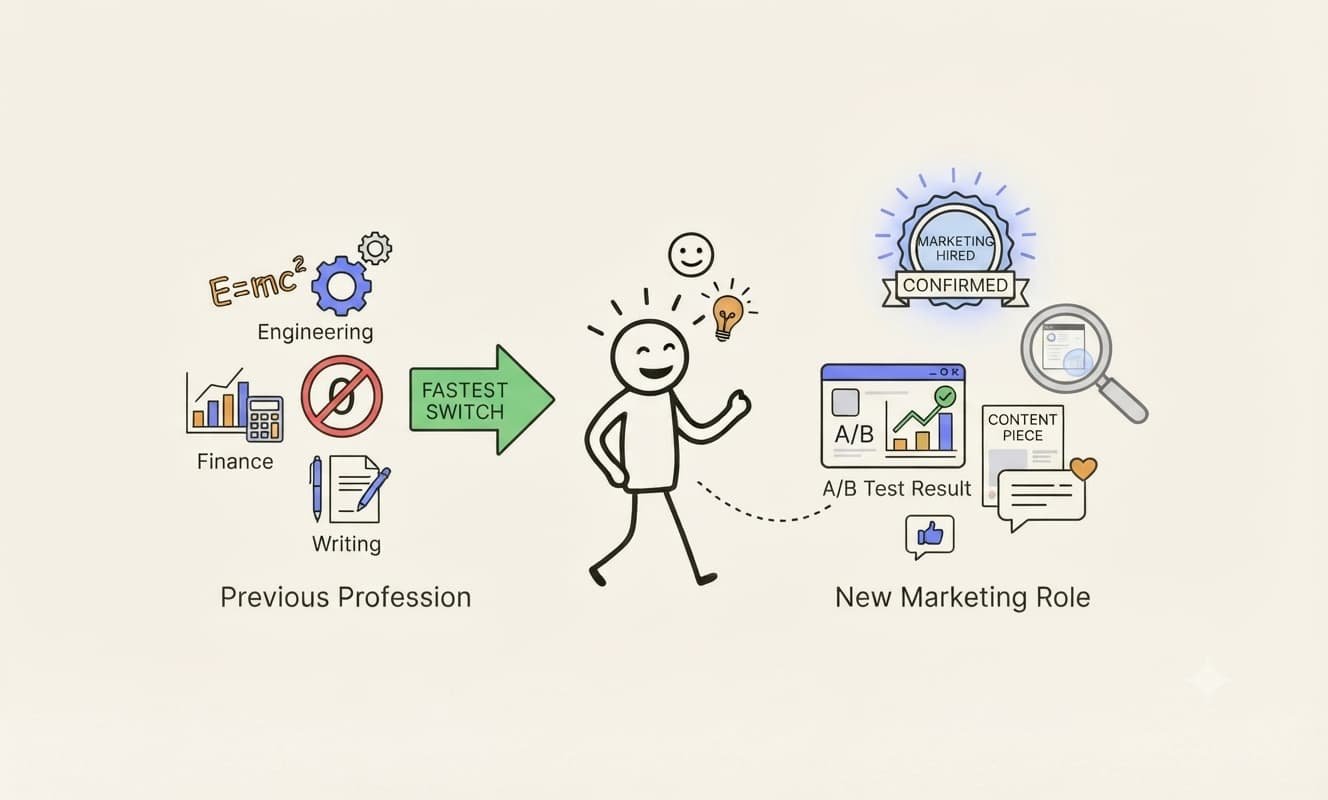
It’s usually not too late for a career switch to marketing. Marketing has no single entry exam, and many marketers come from engineering, sales, finance, design, writing and customer support. What matters is proof that you understand customers and can get results. The fastest switch uses what you already know, picks one marketing skill, and shows real work instead of collecting certificates.
Internet Culture · Overthinking Marketing · 005
The belief: “Everyone else started at 21. I’m too late.”
The honest answer: You’re too late to switch as a fresher. You’re right on time to switch as someone who brings something.
Why this is worth ten minutes
- A career switch to marketing goes wrong when people try to start from zero. It goes right when they start from what they already know.
- Certificates feel productive. Proof gets you hired.
- Your current job may be the easiest place to make the switch.
1 The room
Arjun, 29, is a software engineer at a large IT company in Pune. He’s good at his job and quietly bored by it.
He’s been reading about marketing for a year. He’s done three online courses. He has two certificates on his LinkedIn. He’s applied for twelve marketing roles and heard back from none.
Every rejection feels like proof he’s too old. It isn’t. The problem is what his application says. It tells recruiters he’s a beginner with certificates. It says nothing about the eight years of skills he already has, many of which marketing teams desperately need.
2 Is it too late to switch to marketing at 25, 30 or 35?
No. But the rules of the switch change with age.
At 21, you can enter marketing as a fresher. Nobody expects you to know anything. You compete on energy and potential.
At 30, you can’t really compete as a fresher. You’ll lose to 22-year-olds who cost less and have more free time for internships. If you try to switch to marketing by pretending you’re starting from scratch, it will feel too late.
The way in is different. You don’t compete as a beginner. You compete as someone who brings a skill marketing teams need: understanding data, knowing customers, closing deals, writing clearly, understanding a specific industry.
Marketing is unusual. There’s no licensing exam and no single required degree. Teams hire people who can show they understand customers and can move a number. That door stays open at 25, 30 and 35.
3 Which backgrounds make a career switch to marketing easier?
Almost every background carries something useful. The trick is knowing what.
| Your background | What carries over | Roles worth targeting first |
|---|---|---|
| Engineering and IT | Data, logic, how products are built | Growth marketing, marketing analytics, product marketing at tech companies |
| Sales | Customer objections, persuasion, closing | Product marketing, B2B marketing, lifecycle and CRM |
| Finance and accounting | Numbers, margins, forecasting | Performance marketing, growth, marketing finance |
| Design | Visual thinking, layout, brand feel | Brand design, creative, social media |
| Journalism and writing | Storytelling, research, clear writing | Content marketing, PR, copywriting |
| Customer support | The exact words customers use, their real problems | CRM, community, customer research |
| Teaching | Explaining complex ideas simply | Content, education marketing, community |
Look at the right column. None of these are “entry-level general marketing”. They’re specific roles where your old skill is an advantage, not something you hide.
THE CARRY-OVER AUDIT
Before you learn anything new, list what you already know that marketing teams need. Your switch should start from that list, not from zero.
Rule 1. List your skills in plain words. “I can read data and find patterns.” “I know why customers say no.” “I can explain complex things simply.”
Rule 2. Match each one to a marketing role. Use the table above as a starting point.
Rule 3. Lead with it everywhere. Your CV, your LinkedIn headline and your interviews should start with what you bring, not with “aspiring marketer”.
4 The mechanism stack
01. Your current company may be the easiest door. Internal transfers are often simpler than outside hires. Your company already trusts you. Offer to help the marketing team with analysis, writing, customer insights or anything that uses your strengths. A few months of side work can turn into a role.
02. Proof beats certificates every time. A certificate shows you watched videos. A real project shows you can do the work. A hiring manager will remember “I ran ads for a local café and halved their cost per order” far more than “Completed Digital Marketing Course.”
03. Pick one skill, not ten. Most switchers try to learn SEO, ads, social, email and analytics all at once. They end up shallow in everything. Choose the one that best matches your carry-over skill and get properly good at it.
04. Expect a short step back in title, not in thinking. You may move into a role with a more junior title than you hold today. That’s normal for a career change. But you bring maturity, work habits and business sense that most juniors don’t. That advantage shows quickly.
05. Small real projects build reps fast. Freelancing for a small business, helping a friend’s startup, or running your own page teaches more in three months than a year of theory. Real stakes, even small ones, teach you what actually matters.
5 The counter-weight
Some roles are crowded. General digital marketing and social media roles get huge numbers of applications. Switching into these with no proof is hard at any age. Specific roles linked to your past skills are easier to land.
Pay can dip at first. Depending on where you’re coming from, especially well-paid IT roles, your first marketing salary may be lower. Plan your finances before you make the move.
It takes months, not weeks. A realistic switch, with skill building, projects and job hunting, often takes six months to a year. Anyone promising a 30-day switch is selling something.
Not every company welcomes switchers. Some hiring managers still prefer people with traditional marketing backgrounds. You’ll get rejections. They’re about fit, not about your age.
Marketing isn’t all creative fun. A lot of the job is reports, meetings, budgets and fixing things that broke. Make sure you want the real job, not just the exciting parts you see on LinkedIn.
Internet Culture verdict desk
You’re not too late to start marketing. You’re only too late to start it as a beginner, and you were never going to be one anyway.
6 Steal this: your first 90 days
01. Do the Carry-Over Audit this weekend. Write five skills you already have and match each to a marketing role.
02. Pick one target role from the table. Just one.
03. Learn the core skill for that role properly. Free official courses from platforms like Google and Meta are a fine starting point, but treat them as the beginning, not the finish line.
04. Do three real projects in 90 days. Write three brand breakdowns, run a small ad campaign for a local business, or help a friend’s startup grow their page. Document what you did and what happened.
05. Publish your work. Share each project on LinkedIn with what you learned. This becomes your portfolio.
06. Talk to ten marketers who switched careers. Ask how they did it. One of them might know about an opening.
07. Ask about an internal move. Tell your manager or HR you’re interested in marketing and offer to help on a project.
7 Frequently asked questions
Is it too late to switch to marketing at 30?
No. Many people make a career switch to marketing at 30 or later. The key is not to compete as a fresher, but to bring skills from your current field, such as data analysis, sales, writing or customer knowledge, into a marketing role where those skills are valuable.
How do I switch to marketing with no experience?
Start by listing the skills you already have that marketing teams need. Pick one marketing role that matches them, learn its core skill, and do real projects such as brand breakdowns or small campaigns for local businesses. Real work shows ability far better than certificates alone.
Which background is best for a career switch to marketing?
Many backgrounds work well. Engineers often move into growth and analytics, salespeople into product marketing and B2B, finance professionals into performance marketing, writers into content and PR, and customer support staff into CRM and community roles.
Are marketing certificates enough to get a job?
Usually not on their own. Certificates show you’ve studied, but hiring managers want proof you can do the work. Combine any course with real projects and documented results to make your application stand out.
How long does a marketing career change take?
A realistic marketing career change often takes six months to a year, including learning a core skill, building projects and applying for roles. Internal transfers at your current company can sometimes be faster.