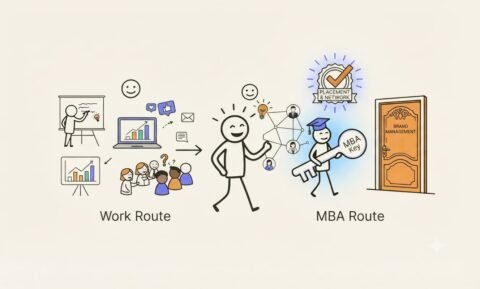
Three years at an agency. Late nights, tight deadlines, six brands at once. You finally apply for an in-house brand role. The feedback comes back in two words: “too agency”. Suddenly you’re wondering if those three years were a mistake.
Summary
Agency vs In-house marketing: No. Agency experience is not bad for your marketing career. Agencies give you speed, variety and many repetitions across different brands. In-house roles give you depth, ownership of results and a view of the whole business. The real risk is staying anywhere so long that you only know one half. Most strong marketers have both, and the order matters less than people think.
Internet Culture · Overthinking Marketing · 004
The belief: “Agency experience will hold me back with brands.”
The honest answer: It only holds you back if you can’t explain it in business language.
Why this is worth ten minutes
- The agency vs in-house marketing debate is usually framed as “which is better”. The useful question is “what does each one teach, and what am I missing?”
- “Too agency” is rarely about your skills. It’s about how you describe them.
- The fix takes days, not years.
1 The room
Sneha is a senior account manager at a mid-sized agency in Mumbai. She has launched campaigns for a bank, a beauty brand, an ed-tech app and a snack company. She can turn a brief around in 48 hours.
She interviews for a brand manager role at a D2C company. The interview goes well, until one question.
“What happened to sales after that campaign?”
She doesn’t know. The agency delivered the campaign, the client was happy, and the next brief arrived. She never saw what happened six months later.
That’s what “too agency” usually means. Not “you’re bad at marketing”. It means “we’re not sure you’ve lived with the results.”
2 Agency vs in-house marketing: what’s the real difference?
Both teach real marketing. They teach different halves of it.
| Agency | In-house | |
|---|---|---|
| What you get a lot of | Brands, briefs, categories, deadlines | Time with one business and one customer |
| What you learn fastest | Craft, speed, presenting, handling pressure | Consequences, numbers, cross-team work |
| How success is measured | Client happiness, delivery, awards | Revenue, retention, growth, margins |
| What you rarely see | What happened after the campaign ended | Many different categories and approaches |
| Typical frustration | Long hours, changing briefs, no ownership | Slower pace, internal politics, approvals |
| What it builds | Range | Depth |
An agency is like doing a hundred practice matches against different opponents. In-house is like playing one long season for the same team and living with the results table.
3 Why do brands say “too agency”?
When hiring managers say it, they usually mean one of four things.
“You talk about deliverables, not outcomes.” Your CV says “launched campaign for X”. They want to know what it changed.
“You haven’t seen the P&L.” Many agency roles never show you margins, CAC or retention data. Brands worry you’ll spend money without thinking about what it returns.
“You’re used to receiving briefs, not writing them.” In-house, nobody hands you a neat brief. You have to figure out what the business needs first.
“You might find the pace slow.” Brands sometimes worry agency people will get bored with one product and leave.
Every one of these is fixable. Most of them are fixed by how you tell your story, not by going back and doing different work.
THE REPS AND DEPTH RULE
Agencies give you reps. In-house gives you depth. A strong marketing career needs both. Notice which one you’re short on, and go get it.
Rule 1. Reps teach range. Many brands, many categories, many briefs. You learn what works across situations.
Rule 2. Depth teaches consequences. One business, one customer, one set of numbers. You learn what your decisions actually cost.
Rule 3. Translate reps into depth language. When you move from agency to brand, describe your work in outcomes, numbers and customer understanding.
4 The mechanism stack
01. Agencies compress experience. In one year at an agency, you might work across five categories. An in-house marketer might see one. That range is a real advantage. You’ve seen what works for a bank and a beauty brand, which helps you spot patterns others miss.
02. In-house teaches you to live with your decisions. Launch a campaign in-house and you’ll still be there when the results come in. You’ll see the returns, the customer complaints, the retention dip. That feedback loop is what agency life often lacks.
03. The translation problem is the real blocker. Most agency portfolios describe outputs: “Created a 360° campaign.” Brands want outcomes: “Helped grow app installs in two new cities.” Same work. Different language. The agency to brand switch is often a rewriting job.
04. Timing matters, but not as much as people fear. Many marketers find a natural point to switch after a few years, while they’re still learning but have real range. Waiting much longer isn’t fatal. It just means you’ll need to work harder on the outcomes story.
05. Startups are a third path. An early-stage startup in-house role often feels like an agency in speed and like a brand in ownership. For agency people, it can be an easier first move than a large company.
5 The counter-weight
Some agencies teach craft better than any brand. The best creative and media agencies build skills in copywriting, design and storytelling that most in-house teams can’t match. Agency experience is not “lesser”. It’s different.
In-house isn’t always better. Many brand roles involve more meetings, approvals and politics than actual marketing. Some in-house marketers spend years managing agencies without ever doing the work themselves.
Agency careers can go all the way to the top. Creative directors, strategy heads and agency founders build excellent careers without ever moving in-house. Switching is an option, not a requirement.
Not every in-house role gives you real ownership. A brand job where you never see the numbers can be just as limiting as an agency job. Ask about the metrics you’ll own before you accept.
Burnout is real on both sides. Agency hours can be brutal. In-house pressure from leadership can be just as heavy. Choose based on what you want to learn, not just on escaping what you’re tired of.
Internet Culture verdict desk
Agency experience isn’t a weakness on your CV. Describing it like a list of deliverables is.
6 Steal this
01. Rewrite your top three portfolio pieces as outcomes. What changed for the client: sales, installs, awareness, search interest? Use whatever data you can get.
02. Ask your current clients for results. Many will share how a campaign performed if you ask. Most agency people never ask.
03. Learn the business behind your briefs. For your biggest client, find out how they make money, what their margins look like and who their customers are.
04. Volunteer for anything that shows numbers. Reporting, post-campaign reviews, business presentations. Get closer to the outcomes.
05. Decide what you’re short on: reps or depth. Choose your next role to fill that gap, not to copy what others are doing.
06. Talk to five people who made the agency to brand switch. Ask what they wish they’d known.
7 Frequently asked questions
Is agency experience bad for a marketing career?
No. Agency experience builds speed, range and craft across many brands. It only becomes a problem if you can’t explain your work in terms of business results when applying for in-house roles.
Agency vs in-house marketing: which is better for a career?
Neither is better overall. In the agency vs in-house marketing choice, agencies offer variety, speed and skill-building across categories, while in-house roles offer depth, ownership of results and business understanding. Many strong marketers do both at different stages.
How do I switch from an agency to a brand role?
Rewrite your portfolio to focus on outcomes, not deliverables. Get results data from clients, learn the business model behind your work, and show you understand metrics like CAC, retention and margins. Early-stage startups can be an easier first in-house move.
What does “too agency” mean in marketing interviews?
It usually means the hiring manager isn’t sure you’ve lived with the long-term results of your work, seen business numbers, or written your own briefs. It’s often a communication gap rather than a skills gap.
When should I move from an agency to in-house?
There’s no fixed rule. Many marketers move after a few years, once they have strong range but want ownership and depth. The best time is when you notice you’ve stopped learning new things in your current role.