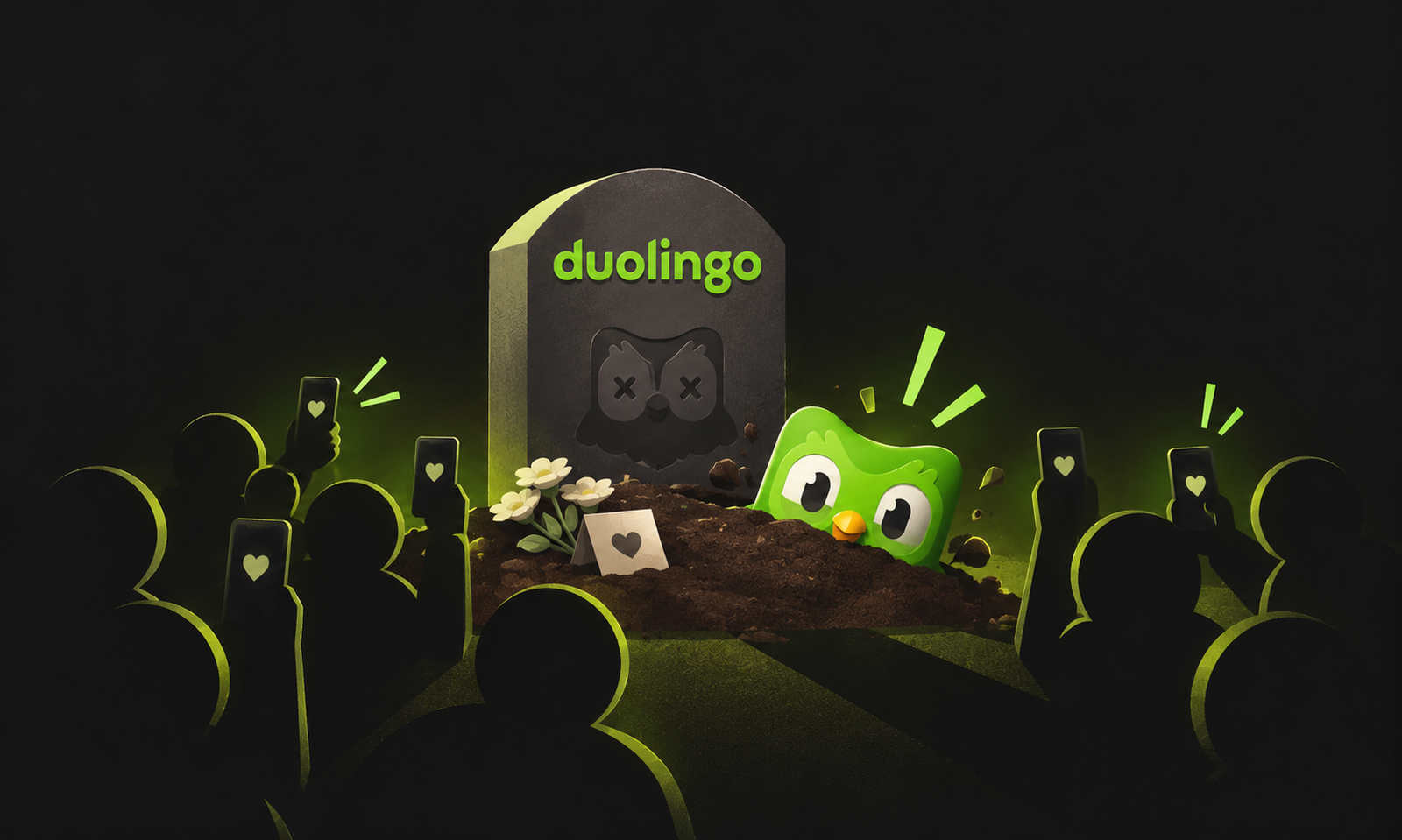
In February 2025, a listed education company told the world its mascot had died. Brands posted condolences. Strangers held memorials. Weeks later, the owl came back. It looked like the silliest thing a public company had ever done. It was also one of the cheapest ways anyone has bought that much attention.
Summary
Duolingo marketing strategy works because its owl mascot is not just a funny logo. Duo acts out the app’s real product: the daily streak and the nagging reminder. Every joke about the owl chasing you is secretly an ad for the habit system. That, plus a social team trusted to post fast, turned a learning app into a character the internet keeps talking about for free.
Internet Culture · Decode 006 · Teardown by the desk
Why this is worth ten minutes
- Everyone explains the Duolingo owl as “Gen Z humour”. That explains the jokes, not why they sell anything.
- The Duolingo marketing strategy has a hidden link between the mascot and the product that most copycats completely miss.
- In 2025 the same brand also showed how fast that goodwill can turn. Both halves teach something.
1 The scene
You haven’t opened Duolingo in two days. A notification arrives. The green owl looks disappointed. Then slightly threatening.
You laugh. You open the app. You do a lesson, mostly so the owl leaves you alone.
Now scroll Instagram or TikTok. The same owl is there, dancing to trending audio, showing up in other brands’ comments, being dramatic about people skipping Spanish.
Marketing Twitter called it “unhinged”. Fair. But unhinged is a style, not a strategy. The real question is what all that chaos is attached to.
2 What is Duolingo’s marketing strategy, really?
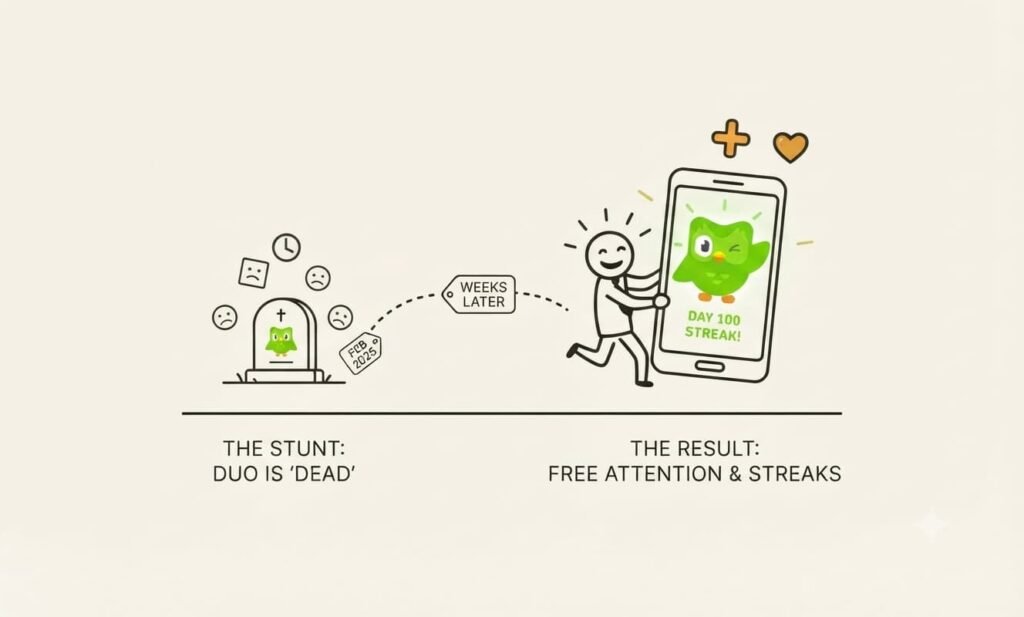
On the surface, the Duolingo marketing strategy is simple. Post a lot. Jump on trends early. Let the mascot be weird.
Underneath, it’s built on one smart link.
Duolingo’s product runs on habit. Streaks count how many days in a row you’ve practised. Reminders nudge you when you slip. Miss a day and you feel it. The whole app is designed to make you come back daily.
Now look at Duo’s personality. Needy. Dramatic. Slightly menacing when you skip lessons. Always watching.
That’s not a random personality. It’s the streak system with a face.
So every meme about the Duolingo owl “hunting you down” is also an explanation of how the app works. Someone who has never used Duolingo learns, through a joke, that this app will push you to show up every day. For a learning app, that’s exactly the promise worth making.
3 Why did killing the Duolingo owl work?
On 11 February 2025, Duolingo announced that Duo had died. The tone was mock-serious. Other brands played along. Fans made tribute posts. The company invited people to keep learning in Duo’s memory.
A few weeks later, Duo came back.
Here’s why that stunt worked better than a normal campaign would have.
It had a story, not just a post. A death, a mourning period and a return is a beginning, middle and end. People follow stories. They scroll past single posts.
It invited people in. Fans, other brands and creators all joined the joke. When thousands of people add their own content, the campaign stops being Duolingo’s and starts belonging to everyone. That’s earned media at a scale no ad budget could buy.
It was built on years of character. The death only meant something because people already knew who Duo was. You can’t kill a mascot nobody cares about. The stunt cashed in years of consistent posting.
It cost very little. The biggest cost was creativity and nerve. The distribution was done by the audience.
THE MASCOT MECHANIC TEST
A mascot works best when its personality acts out what your product actually does. If your mascot could belong to any brand, it’s decoration. If it could only belong to you, it’s strategy.
Rule 1. Start with your product’s core habit or feeling. For Duolingo, it’s the streak and the guilt of missing it. What’s yours?
Rule 2. Turn that into a personality trait. Needy, fast, protective, picky, generous. One clear trait beats five vague ones.
Rule 3. Keep the character consistent. People should be able to guess how your mascot would react to anything. That’s when they start writing the jokes for you.
4 The mechanism stack
01. A character outlasts a campaign. A campaign ends when the budget ends. A character keeps going. Duo isn’t a logo doing gags. He’s a sitcom character with a clear flaw, which means there are endless new situations to put him in. New followers can join at any point and still get the joke.
02. Speed matters more than polish. Trends on short-video platforms move in days, sometimes hours. Duolingo’s social team became known for posting fast and in the platform’s own style. A rough video posted today beats a polished one posted next month.
03. Trust is the hidden advantage. The hardest part of this social media strategy to copy isn’t the humour. It’s the approval process. Most brands need legal, brand and leadership sign-off before a single post goes live. By then, the trend is dead. Duolingo’s team reportedly had room to move fast within clear limits.
04. Commenting is distribution. Duo shows up in other brands’ comment sections and in trending conversations. Each appearance puts the brand in front of a new audience for free. It works like a guest appearance on someone else’s show.
05. The joke points back to the product. Even the silliest Duolingo content usually connects to lessons, streaks or learning. That keeps the entertainment tied to a reason to download the app.
5 The counter-weight
Nobody can prove exactly how much the memes sold. Duolingo’s own shareholder letters showed daily active users growing strongly in this period. But growth also came from product improvements, new courses and features. The filings don’t isolate how much came from social media. Anyone giving you a precise number is guessing.
It only works for some brands. A pushy, slightly menacing mascot works when the stakes are low, like learning a language. The same behaviour from a bank, a hospital or an insurance app would scare people away. Know your category before you copy the tone.
Unhinged needs to keep escalating. Weird gets normal fast. Each stunt has to be bigger than the last to get the same reaction. Killing the mascot may have been, in part, a sign that the old format needed a bigger story to stay fresh.
Goodwill can disappear quickly. In April 2025, Duolingo’s CEO shared a memo about becoming “AI-first”, including using less contract work where AI could do the job. Many users reacted badly. Comments filled with anger, and Duolingo briefly went quiet on some social channels. The lesson: a loved character can’t protect you from a decision your audience dislikes. The voice and the company are judged together.
Copycats mostly failed. Many brands told their teams “be like Duolingo”. The result was chaos without a character, random jokes with no link to the product. They copied the noise and missed the mechanism.
Internet Culture verdict desk
Duolingo didn’t buy attention. It built a character the internet wanted to keep writing stories about, and then let the internet pay the media bill.
6 Steal this
01. Run the Mascot Mechanic Test. Write down your product’s core habit or feeling, then the personality trait that matches it.
02. Give your social team a clear sandbox: what’s allowed, what’s off limits, and who needs to approve what. Then let them post within it without waiting for five sign-offs.
03. Plan one story arc per quarter with a beginning, middle and end, instead of 90 days of unrelated posts.
04. Spend 20 minutes a day showing up in relevant conversations and comment sections, in your brand’s voice.
05. Track the reach you didn’t pay for. Add “earned impressions” next to paid reach in your monthly report.
06. Before any big company announcement, ask how your community will hear it. Your brand voice and your business decisions are seen as one thing.
7 Frequently asked questions
What is Duolingo’s marketing strategy?
Duolingo marketing strategy centres on Duo, an owl mascot with a needy, slightly menacing personality that mirrors the app’s streak and reminder system. Duolingo posts fast, native content on platforms like TikTok and Instagram, joins trends early, and uses big story-driven stunts that fans and other brands join in on.
Why did Duolingo kill its mascot?
In February 2025, Duolingo announced Duo had “died” as a story-driven stunt. It created a beginning, middle and end that fans and brands could join, generating huge free attention. Duo returned a few weeks later.
Why is the Duolingo owl so popular?
The Duolingo owl is popular because it has a clear, consistent personality that people can predict and joke about. Its behaviour, nagging users to practise, matches what the app actually does, so the humour feels connected to a real experience most users share.
Can other brands copy Duolingo’s social media strategy?
Brands can copy the principles: build a character tied to the product, let the social team move fast within clear limits, and tell stories over time. Copying the jokes alone usually fails, and a pushy tone suits low-stakes categories better than serious ones like finance or healthcare.
Did Duolingo face backlash on social media?
Yes. In 2025, an “AI-first” memo from Duolingo’s CEO drew strong negative reactions from many users, and the brand briefly went quiet on some social channels. It showed that even a much-loved brand voice is judged alongside the company’s decisions.