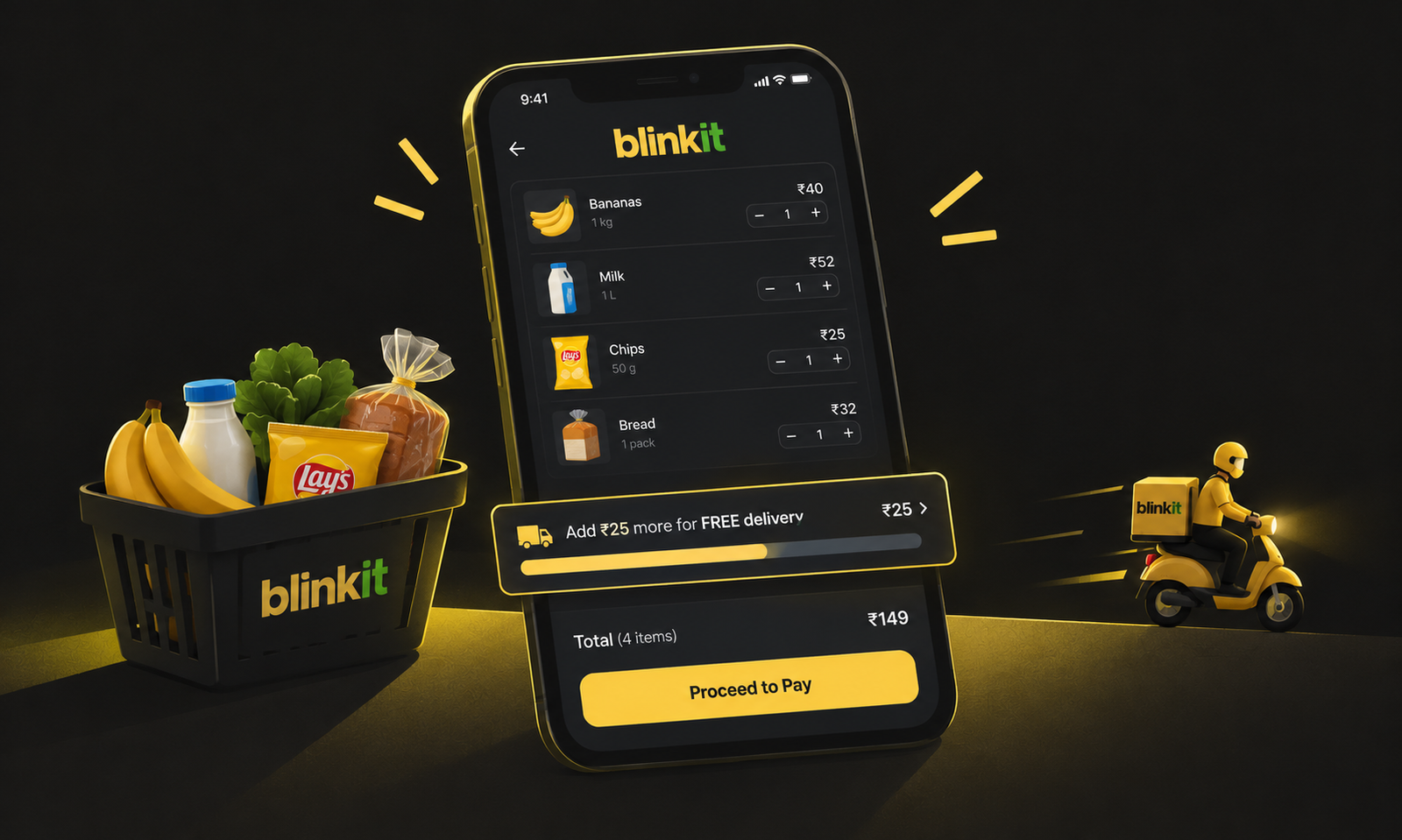
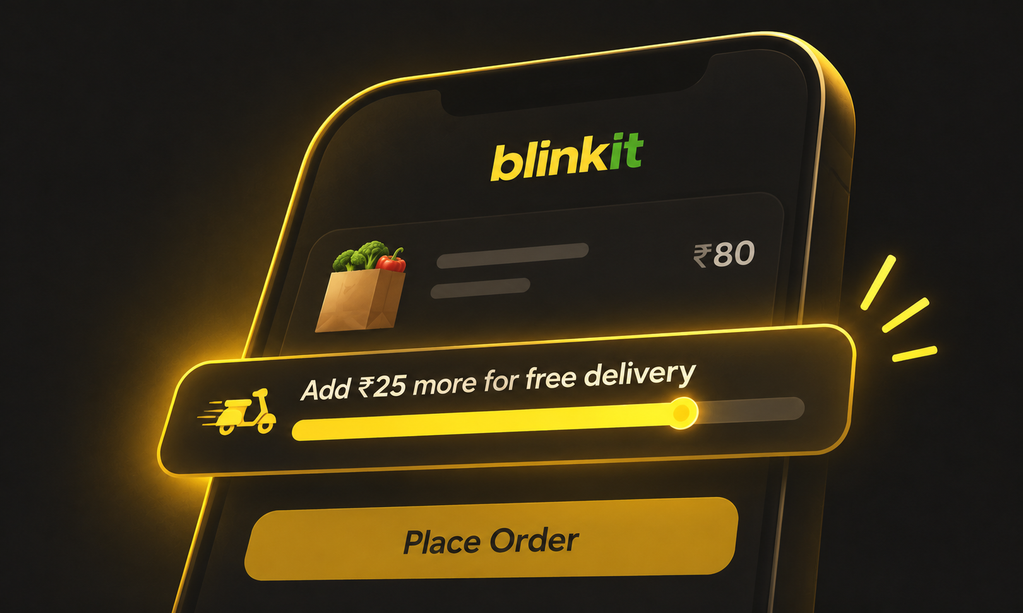
The thin gold line at the bottom of your Blinkit cart looks like a courtesy. It is a pricing instrument built on the goal gradient effect, and it is doing more for quick commerce unit economics than any discount, any ad, or any celebrity endorsement ever has.
Summary
Blinkit’s free delivery progress bar uses the goal gradient effect to lift average order value at the exact moment of checkout. The reason it matters is not persuasion. Rider cost in quick commerce is roughly fixed per drop, so a larger basket spreads that fixed cost across more revenue. The progress bar is not a nudge bolted onto the app. It is the mechanism that makes the fixed cost of a ten minute delivery survivable.
Why this is worth ten minutes
- Free delivery thresholds are usually taught as a psychology trick. They are actually a cost allocation strategy, and the goal gradient effect is only how that strategy gets executed.
- The goal gradient effect is the most reliably monetisable finding in behavioural science, and almost no Indian brand outside quick commerce uses it correctly.
- Customers do not hate spending money. They hate paying for things with no perceived product attached. That single distinction explains the entire economics of shipping fees.
- The same mechanic runs your loyalty programme, your onboarding checklist, your referral tier and your LinkedIn profile completion score. Once you see it, you cannot unsee it.
1 The scene
Your cart says ₹119. Under it, a slim gold line, maybe seventy percent filled, with a sentence you have read a thousand times and never once read carefully.
Add items worth ₹80 more for free delivery.
The delivery fee you are avoiding is ₹25. You add a packet of chips, a Diet Coke and something with almonds in it. You pay ₹204. You saved ₹25 by spending ₹85.
Marketing Twitter has a word for this. Dark pattern. Manipulation. The app exploiting your lizard brain for the sake of a snack margin.
That reading is correct in spirit and completely wrong in scale. It assumes the progress bar is a persuasion tactic sitting on top of a business. It is not. In quick commerce, the progress bar is the business, and the goal gradient effect is just the delivery mechanism for an accounting problem that nobody has solved any other way.
2 What is actually happening in the cart
Blinkit, like Zepto and Swiggy Instamart, operates a dark store model. A small, high-density warehouse serves a radius of roughly two to three kilometres. A rider picks up a packed order and rides it to a customer inside that radius. The whole thing takes ten to fifteen minutes.
Now look at the cost of that ride.
The rider is paid per drop. The picker is paid to pack the order. The packaging material is consumed per order. The last mile does not care whether the bag contains one bottle of milk or twenty two items. The cost of moving the bag from the store to your door is close to fixed, no matter what is inside it.
That is the single most important sentence in this article, so read it again.
Quick commerce has a largely fixed cost per drop and a highly variable revenue per drop.
Everything else follows from that asymmetry.
3 Why does the goal gradient effect make you spend ₹80 to save ₹25?
Run the arithmetic the way the operator runs it, not the way the customer feels it.
Assume, purely as an illustrative model, that the all-in cost of getting one order to one door is around ₹40. Rider payout, picking labour, packaging, a slice of dark store rent and electricity.
Visualize
| Basket value | Fixed drop cost | Drop cost as share of basket |
|---|---|---|
| ₹119 | ₹40 | 34 percent |
| ₹204 | ₹40 | 20 percent |
| ₹450 | ₹40 | 9 percent |
| ₹900 | ₹40 | 4 percent |
Those are modelled numbers, not disclosed ones. The exact figures move by city, by hour and by how much of the rider fleet is on surge. But the shape of the table is not in dispute and it is the entire reason the gold line exists.
At ₹119, the order is a loss almost regardless of product margin. Grocery gross margins in India are thin. A third of the basket going to logistics is not a bad quarter, it is a broken model.
At ₹204, the same ₹40 is suddenly survivable.
The ₹25 delivery fee was never the point. The ₹25 is bait. What Blinkit is actually buying with that waiver is a basket large enough to absorb a fixed cost. It gives up ₹25 of fee revenue and receives ₹85 of additional GMV, of which it keeps the product margin, plus it moves the single worst ratio in its P&L in the right direction.
Charging ₹25 fixes nothing. Growing the basket fixes everything.
The reframe
A free delivery threshold is not a discount. It is a minimum viable basket, expressed in a language the customer will accept. The number on the bar is not chosen by a marketer who likes round figures. It is the point at which the order stops being a liability.
4 What is the goal gradient effect and why does it work at checkout?
Now the psychology, because knowing the threshold is right does not tell you why people obey it.
In 1932, the behaviourist Clark Hull put rats in a runway and measured their speed toward food. They ran faster the closer they got. He called it the goal gradient hypothesis: motivation increases as perceived distance to a reward decreases.
Seventy years later, Ran Kivetz, Oleg Urminsky and Yuhuang Zheng tested the goal gradient effect on humans with coffee cards, published in the Journal of Marketing Research in 2006. Customers bought coffee faster as they approached a free drink. Not because the drink got better. Because the gap got smaller.
Joseph Nunes and Xavier Drèze ran the version that matters more for your business, published the same year. A car wash loyalty card. One group got an eight-stamp card, blank. Another got a ten-stamp card with two stamps already applied. Identical work required. The pre-stamped group completed the card at a substantially higher rate.
The finding underneath both studies is not “people like rewards.” People like rewards regardless. The finding is:
Progress is more motivating than the prize.
A ₹25 saving, presented as a ₹25 saving, is uninteresting. A ₹25 saving presented as a bar that is seventy percent full is a task. And humans are extremely bad at leaving tasks unfinished, which is a separate effect called the Zeigarnik effect and it is stacking right on top of the goal gradient effect.
Blinkit is not asking you to save money. It is showing you an incomplete thing and trusting you to be human about it.
5 The mechanism stack
01. Endowed progress. You never start the bar at zero. By the time you see it, you already have items in the cart, which means you are already partway to the reward. The threshold is framed as almost-done, never as far-away. This is the Nunes and Drèze finding, deployed at scale, on a cold start.
02. Loss framing on a fee, not a product. Consumers respond disproportionately badly to fees for services they perceive as having no product value. The ₹25 is not resented because it is ₹25. It is resented because you get nothing for it. A packet of chips at ₹85 costs more and feels better, because chips are a thing and delivery is not.
03. Gap specificity. The bar does not say “spend more”. It says ₹80. A precise gap converts a vague intention into a solvable problem. This is the same reason “lose weight” fails and “walk eight thousand steps” works.
04. Solution proximity. Next to the bar sits a rail of products priced almost exactly at the gap. Not accidentally. The recommendation engine’s job at that moment is not relevance, it is gap closure. The optimal recommendation is the cheapest item that clears the threshold and carries the fattest margin.
05. Repeat compression. Quick commerce is a frequency business. The goal gradient effect is not a one-time trick here. It trains a habit. Over months, the customer’s default basket size rises, because they have learned that below a certain number the app charges them. The nudge becomes a norm, and norms do not need nudging.
THE GAP TAX
The Gap Tax is the amount a customer voluntarily spends to erase a visible shortfall, divided by the fee they were avoiding.

In the example above: ₹85 spent to avoid ₹25. Gap Tax of 3.4x.

Any Gap Tax above 1.0 means the seller collected more revenue than the fee it forfeited. The mechanism is only profitable when the incremental items carry margin above the forfeited fee, which is why the recommendation rail beside the bar is never showing you milk.

The test that goes with it: can your customer see, in one glance, exactly how far they are from a reward, at the exact moment they are deciding? If they have to compute the gap themselves, the gap does not exist.
The Gap Tax is the amount a customer voluntarily spends to erase a visible shortfall, divided by the fee they were avoiding.
In the example above: ₹85 spent to avoid ₹25. Gap Tax of 3.4x.
Any Gap Tax above 1.0 means the seller collected more revenue than the fee it forfeited. The mechanism is only profitable when the incremental items carry margin above the forfeited fee, which is why the recommendation rail beside the bar is never showing you milk.
The test that goes with it: can your customer see, in one glance, exactly how far they are from a reward, at the exact moment they are deciding? If they have to compute the gap themselves, the gap does not exist.
6 The counter-weight
A teardown that only admires is a brochure. Here is the argument against everything above.
The customer is worse off, and that matters. Net cash out went up. The customer experienced a saving and paid more. You can argue they wanted the chips. You can also argue that “wanted” is doing suspicious work in that sentence, because the want was manufactured eleven seconds earlier by a gold line. The honest position is that this is a mild, transparent, legal nudge that reliably transfers money from consumer to platform, and calling it a service is a stretch.
The real dark pattern risk is next door. The progress bar itself is not deceptive. It states a number and honours it. The danger is what sits beside it in Indian quick commerce apps: handling fees, small cart fees, surge fees, rain fees, some of which surface late in the flow. India’s Central Consumer Protection Authority published its guidelines on dark patterns in 2023, naming drip pricing and basket sneaking among thirteen specified patterns. A clearly disclosed threshold is defensible. A threshold that is cleared and then followed by three new fees is not.
It is not incrementality. Some share of threshold-crossers were going to buy those chips anyway, on this order or the next one. The goal gradient effect may be pulling forward a purchase rather than creating one, in which case the platform gave up ₹25 of real fee revenue to reshuffle its own calendar. Only a holdout test tells you which, and nobody publishes those.
The mechanic has a ceiling. Thresholds raise basket size until they suppress order frequency. Set it too high and the customer stops placing the small urgent order that made quick commerce feel magical in the first place. The category was built on “I need one thing, now.” Every rupee you add to the threshold taxes that promise.
Everyone has it, so nobody owns it. Zepto has it. Instamart has it. Amazon has it. A mechanic available to every competitor is not an advantage, it is a floor. The advantage is in threshold-setting accuracy by cohort and city, which is a data problem, not a design problem.
Internet Culture verdict desk
The delivery fee was never a revenue line. It was a lever disguised as a price, and the thing it lifts is the only number in quick commerce that actually matters: rupees per drop.
7 Where else the goal gradient effect is running right now
Once you name it, you find it everywhere, which is the point of naming things.
- Myntra and Ajio free shipping thresholds, identical logic, slower clock
- Swiggy One and Zomato Gold progress toward benefits, framed as membership rather than basket
- LinkedIn profile strength meter, which has no reward at all beyond the bar being full, and still works
- Duolingo streaks, where the gap is days rather than rupees
- Credit card spend milestones, where the Gap Tax runs into thousands
- Amazon Pantry and BigBasket minimum order values, which do the same job without the courtesy of a bar
- Every airline loyalty tier in existence, where people book worse flights in December to avoid dropping a tier
The offline version is older than all of them. “Buy two, get one free” is a progress bar with no interface.
8 Steal this
01. Compute your true fixed cost per order before you set any threshold. Packing, shipping, payment gateway, returns provision, support. Your threshold is not a marketing decision, it is the point where that fixed cost falls below an acceptable share of revenue. Most D2C brands in India set the number by copying a competitor. That is how you inherit someone else’s cost structure.
02. Make the gap visible and specific. Not “spend more for free shipping”. The exact rupee number, updated live, with a bar. If a customer has to do subtraction, you have lost.
03. Never start the bar at zero. Show progress the moment the first item enters the cart. Endowed progress is free and it is the highest-leverage twenty minutes of engineering work in your checkout.
04. Curate the gap-closer rail by margin, not by relevance. The job of that module is to present two or three items priced between the gap and the gap plus twenty percent, with the best contribution margin you have. This is the difference between a nudge that costs you money and one that makes it.
05. Run the holdout. Pick one city or one cohort, remove the threshold, offer flat free delivery, and measure basket size, order frequency and contribution per customer over sixty days. Everyone assumes thresholds win. Very few have checked at their own price point.
06. Do not stack the trick. A transparent threshold followed by surprise fees converts a nudge into a grievance, and grievances in Indian consumer apps now have a regulatory address.
9 Frequently asked questions
What is the goal gradient effect in marketing?
The goal gradient effect is the finding that motivation to complete a task increases as perceived distance to the reward decreases. First demonstrated by Clark Hull in 1932 and validated in consumer contexts by Kivetz, Urminsky and Zheng in 2006. In marketing, the goal gradient effect is applied through progress bars, loyalty stamps, completion meters and free delivery thresholds.
Why do apps like Blinkit offer free delivery above a certain cart value?
Because delivery cost in quick commerce is roughly fixed per order while revenue is variable. A larger basket spreads the same rider and packing cost across more revenue, lowering logistics cost as a percentage of the order. The free delivery threshold is the simplest way to raise basket size without raising prices.
Is a free delivery progress bar a dark pattern?
By itself, no. It discloses the threshold and honours it, so the customer has full information. It becomes problematic when combined with fees revealed late in checkout, which India’s Central Consumer Protection Authority classifies as drip pricing under its 2023 dark patterns guidelines.
How do I set the right free shipping threshold for my store?
Calculate your fully loaded fixed cost per order, then find the basket value at which that cost falls to an acceptable share of revenue, usually ten to fifteen percent for most D2C categories. A threshold set at roughly twenty to thirty percent above your current average order value captures the largest group of reachable customers without suppressing order frequency.
Does the goal gradient effect actually increase profit?
Only if the incremental items carry gross margin greater than the delivery fee you forfeited, and only if the purchase is incremental rather than pulled forward from a future order. Both conditions need a holdout test to confirm. The goal gradient effect is reliable at raising average order value. Whether it raises contribution is a question your own data has to answer.