Your manager just wrote ten captions in under a minute using a chatbot. They were fine. Not great, but fine. You went home that night and typed the same question thousands of marketers type every week. Here’s the honest answer.
Summary
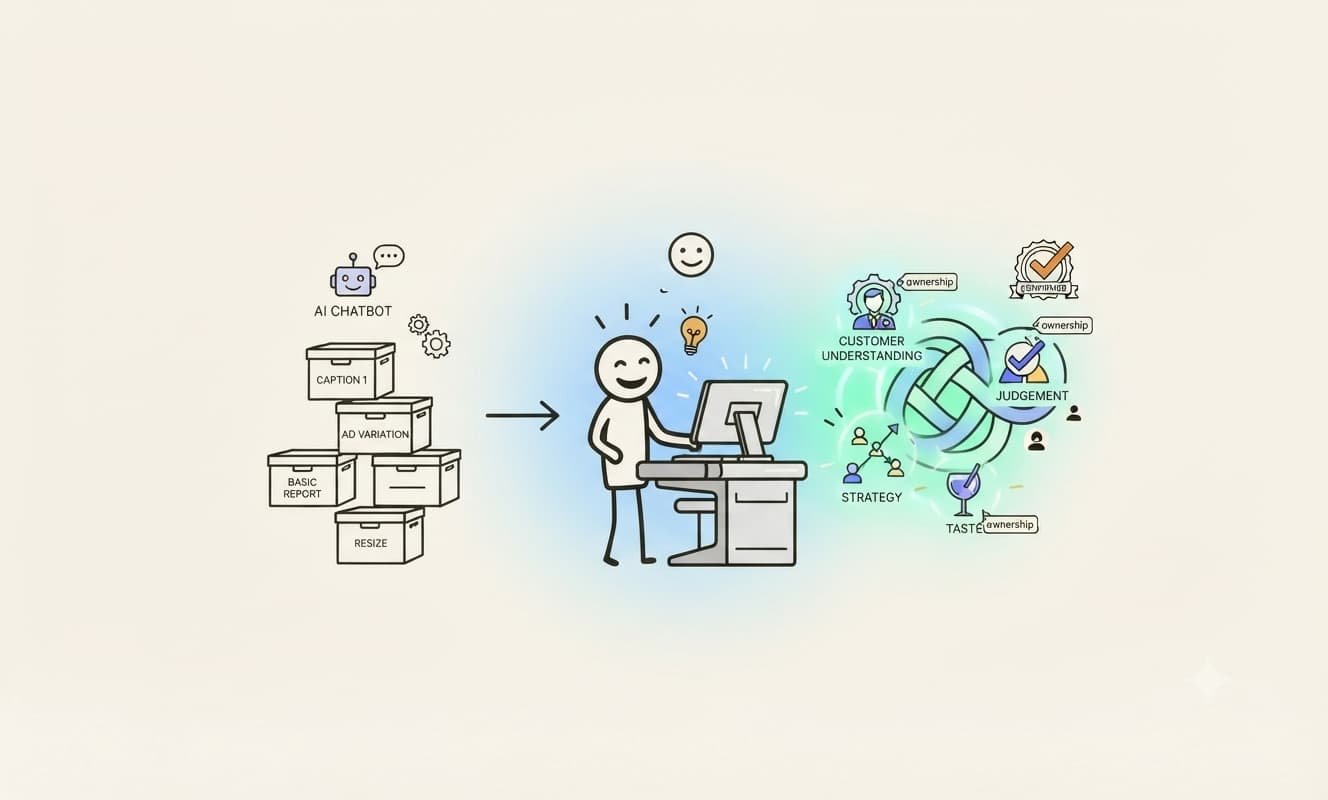
AI will replace a lot of marketing tasks, but not most marketers. Work that is repeatable and easy to check, like first drafts, ad variations, resizing and basic reports, is being automated fast. Work that needs judgement, taste, real customer understanding and ownership of results is becoming more valuable. The marketers most at risk are the ones whose entire job is the repeatable part.
Internet Culture · Overthinking Marketing · 002
The belief: “AI is going to take my marketing job.”
The honest answer: It will take some of your tasks. Whether it takes your job depends on what’s left.
Why this is worth ten minutes
- “Will AI replace marketers” is the wrong question. “Which parts of my week will AI replace” is the useful one.
- When good output becomes cheap, the skill that decides what to make becomes expensive.
- The entry-level ladder is changing, and juniors need to know how before everyone else figures it out.
1 The room
A content writer, 24, has been in her first job for eight months. She’s good. She writes forty social captions a week and a few blog drafts.
In a team meeting, her manager types a prompt and gets twenty captions back in a few seconds. Half are usable. The manager says, “This will save us so much time.” Everyone nods.
She doesn’t sleep well that night.
The fear is fair. But it’s aimed at the wrong thing. Nobody in that room asked who decided what those captions should say, who the customer was, or whether the post would actually move anything. That person still has a job. The question is whether she becomes that person.
2 Will AI replace marketers, or just parts of the job?
Every marketing job is a bundle of tasks. Some of those tasks are execution: making the thing. Some are judgement: deciding what to make, for whom, and why.
AI in marketing is very good at the first kind and still weak at the second.
| Tasks moving to AI fast | Tasks growing in value |
|---|---|
| First drafts of captions, emails and blogs | Deciding what the brand should say and to whom |
| Dozens of ad copy variations | Choosing which idea is actually worth testing |
| Resizing and reformatting creatives | Creative direction and taste |
| Summarising reports and calls | Knowing what the numbers mean for the business |
| Basic keyword lists | Real customer research and interviews |
| Translating templates | Positioning, pricing and brand decisions |
| Routine performance reports | Owning a result and being accountable for it |
So will AI replace marketers? It will replace the left column. A marketer whose whole week sits in the left column has a real problem. A marketer who spends most of the week in the right column just got a very fast assistant.
3 Which marketing jobs are most at risk?
The risk isn’t spread evenly. It follows one pattern: roles measured by how much output you produce are at more risk than roles measured by what that output achieves.
Higher risk: roles built mostly on volume. Bulk content writing. Basic ad variation production. Simple reporting with no analysis. Repetitive design adaptations. If a manager judges your work by “how many did you make,” AI competes with you directly.
Lower risk: roles built on judgement and relationships. Strategy and positioning. Customer research. Brand and creative direction. Community building. Product marketing. Anyone who owns a revenue, retention or growth number and has to explain it to leadership.
Notice something. The lower-risk roles are not the senior ones by default. A junior who talks to customers every week and brings real insights to the team is safer than a senior who only approves drafts.
THE JUDGEMENT LINE
Draw a line through your work week. Below it: tasks where the output is easy to check and repeat. Above it: tasks where someone has to decide, choose or take responsibility. AI is eating everything below the line. Your career lives above it.
Rule 1. Hand the below-line work to AI on purpose. Don’t hide from the tools. Use them to finish execution faster.
Rule 2. Spend the saved hours above the line. Talk to customers. Study the numbers. Form opinions. That’s where your value grows.
Rule 3. Make your judgement visible. If nobody can see you deciding, they’ll assume you’re only executing.
4 The mechanism stack
01. Cheap output makes judgement scarce. When anyone can produce a hundred ads in a minute, a hundred ads stop being impressive. The rare skill becomes knowing which three are worth running. The future of marketing jobs is less about making and more about choosing.
02. Everyone has the same tools, so the tools stop being an edge. Your competitor has the same chatbot you do. When everybody uses the same AI, outputs start to look alike. The difference comes from what goes in: sharper customer insight, a clearer brief, better taste.
03. Someone still has to be responsible. AI can suggest a campaign. It can’t stand in front of the CEO and explain why it failed. Businesses pay people partly to own outcomes. Accountability is very hard to automate.
04. AI read the internet. It didn’t read your customers. A model knows what millions of web pages say about skincare. It doesn’t know what your customers complained about in last week’s WhatsApp support chats. First-hand customer knowledge is the input AI can’t fake.
05. The bottom rung of the ladder is changing. This is the hardest truth. Many juniors learned by doing the execution work that AI now handles. Some companies will hire fewer pure execution roles. That means juniors need to show judgement earlier than previous generations did.
5 The counter-weight
Some jobs really will shrink. Telling everyone “you’ll be fine” is dishonest. Teams that needed five people for content production may need two. That’s real, and it will be uncomfortable for some people.
“Just learn AI” isn’t a strategy. Knowing how to use a chatbot will soon be as basic as knowing how to use email. It’s necessary, but it won’t set you apart for long.
Predictions are often wrong in both directions. Big reports, like the World Economic Forum’s Future of Jobs survey, try to forecast which skills will rise and fall. They’re useful for direction. They’re not a promise about your specific job in your specific city.
AI adoption can backfire on brands. When Duolingo’s CEO shared an “AI-first” memo in 2025, many users reacted angrily. Customers care how companies use AI. Marketers who understand that tension are useful, not replaceable.
Taste can be copied over time. AI keeps getting better at tasks that once needed judgement. The line moves. Staying above it is an ongoing job, not a one-time fix.
Internet Culture verdict desk
AI didn’t make marketing easy. It made the easy parts of marketing free. What’s left is the part that was always hard.
6 Steal this
01. List every task you did last week. Mark each one above or below the Judgement Line. Be honest.
02. Pick the three biggest below-line tasks. Learn to do them with AI, then check the output carefully.
03. Move the saved time to one above-line habit. The easiest one: talk to one customer every week.
04. Own one number. Ask your manager for a metric you’re responsible for, even a small one. Ownership is the clearest proof of judgement.
05. Make your thinking public. Write a short breakdown of a campaign you admire on LinkedIn every month. It shows how you think, not just what you can make.
06. Get good at briefing and editing. A sharp brief and a ruthless edit are the two skills that make AI output actually useful.
7 Frequently asked questions
Will AI replace marketers completely?
Unlikely. AI is replacing many marketing tasks, especially repeatable execution like drafts, variations and basic reports. Work that needs judgement, customer understanding, taste and accountability for results is becoming more valuable, so marketers who focus on that work are in a stronger position.
Which marketing jobs are most at risk from AI?
Roles measured mainly by volume of output, such as bulk content writing, basic ad variation production and routine reporting, face the most risk. Roles built on strategy, customer research, brand direction, community and owning business results face less.
What marketing skills will matter most in the future?
The skills that matter most are judgement, customer research, positioning, clear briefing, editing, understanding business numbers like margins and retention, and taking ownership of results. Using AI tools well is also expected, but it is becoming a basic skill rather than a differentiator.
Should junior marketers be worried about AI?
Juniors face the biggest change, because much of the execution work they learned on is being automated. The best response is to show judgement early: talk to customers, own a small metric, form opinions and share your thinking publicly.
How should marketers use AI in marketing work?
Use AI to speed up execution tasks like first drafts, variations and summaries, then check and edit the output carefully. Spend the time saved on work AI cannot do well, such as customer conversations, strategy and decisions.