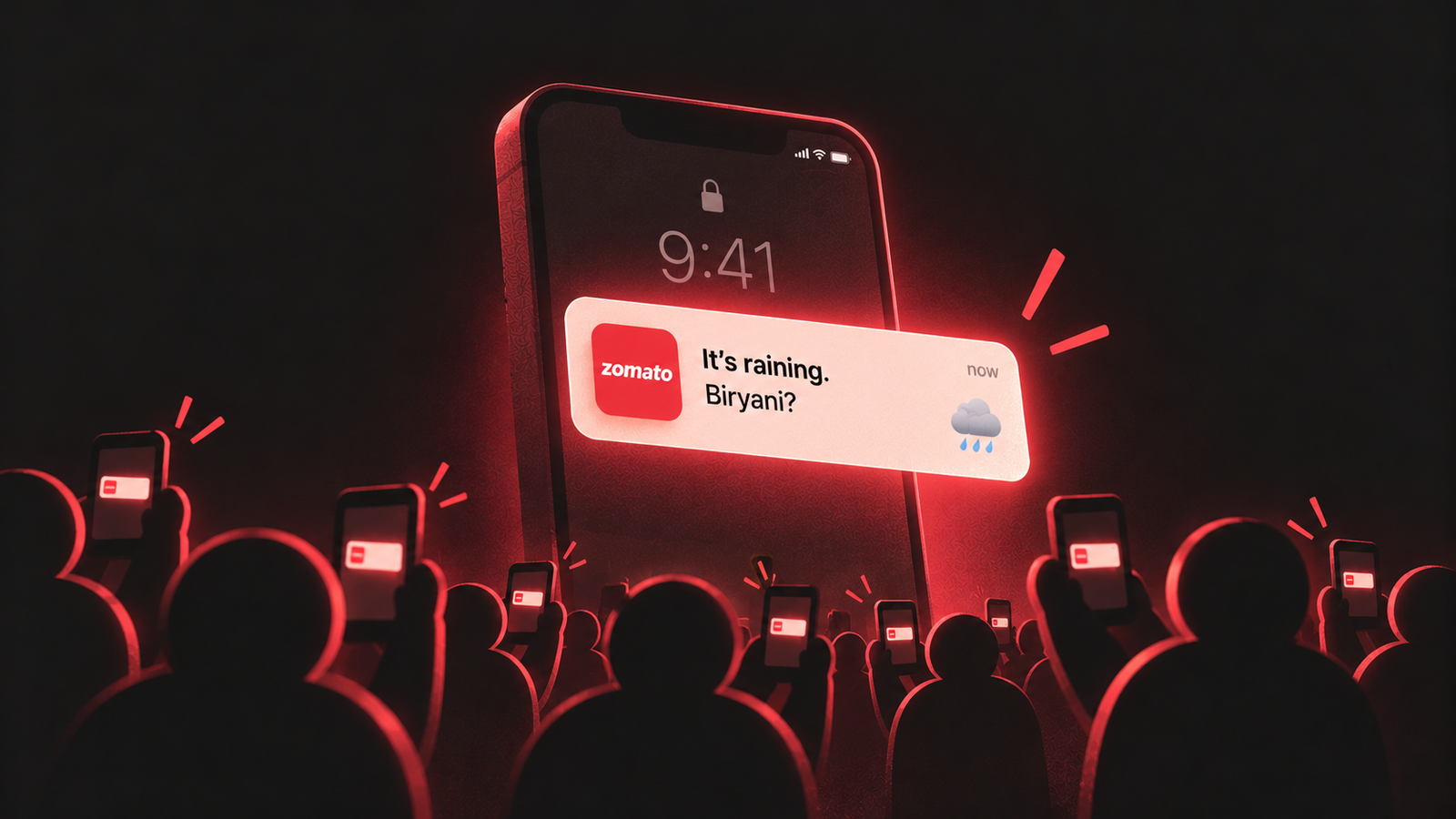
Most brands use push notifications like a loudspeaker. Zomato uses them like a friend who knows it is raining outside. That one difference turned a boring CRM tool into a media channel that people share on their own.
Summary
Zomato push notifications work because they are timed to moments people are already living through, like rain, a cricket match or the 4 PM slump, and they are short enough to read on a lock screen in one glance. The good ones get screenshotted and shared, so a free owned channel produces free reach. The lesson is not “be funny”. It is timing, restraint and respect for the user’s permission.
Internet Culture · Decode 004
Why this is worth ten minutes
- Almost every brand already owns a push channel and uses it to shout discounts. Zomato push notifications show what the same channel can do when you treat it like media.
- The copy gets all the credit. The timing does most of the work.
- There is a real cost hiding under the jokes, and most copycats never see it coming.
1 The scene
It is pouring outside. Traffic is stuck. You are hungry and you do not want to cook.
Your phone buzzes. It is Zomato, and it somehow knows exactly how you feel right now. The line is short and a little cheeky. You laugh. You screenshot it. You send it to the office group.
Look at what just happened. A brand sent you an ad, you enjoyed it, and then you distributed it to twenty people for free. Nobody paid Meta. Nobody paid an influencer.
That is not a copywriting trick. That is a push notification strategy that turned a CRM tool into a small media company.
2 What makes Zomato push notifications different?
Open your notification history and count how many brand pushes you have received this week. Most of them look the same: a discount in capital letters, a few emojis, and a “hurry” at the end.
Those notifications are written for the brand. They say what the brand wants to say.
Zomato push notifications are written for the moment. They show up when something is already happening in your life:
- The first heavy rain of the monsoon
- A big India cricket match
- A festival, or the day after one
- The end of the month, when salaries are thin
- Late at night, when the cravings start
- Whatever the internet is talking about this week
The product being sold never changes. It is food, delivered. What changes is the reason the message feels relevant today. That is moment marketing, applied to a channel most brands treat as plumbing.
3 Why do people share Zomato push notifications?
People do not share ads. They share things that say something about them.
When you forward a funny Zomato notification, you are not promoting a food app. You are showing your friends that you noticed something clever. The notification becomes a small piece of social currency, and the brand name comes along for the ride.
Three things make that possible.
It arrives at the right moment. A rain joke on a sunny day is noise. The same joke during a downpour feels like the brand is standing next to you at the window.
It is short. A lock screen gives you roughly one line. No images, no carousel, no landing page. The whole idea has to land in a glance, which forces the kind of discipline most brand copy never has.
It does not ask for anything. The best ones do not push a coupon. They make you smile first. The order comes later, on its own, because you are now thinking about food.
THE LOCK SCREEN RENT
The lock screen is your customer’s most private screen. You do not own space on it. You rent it, and every notification pays the rent in one of two ways: it is useful, or it is enjoyable. If it is neither, the user evicts you with one tap.
Rule 1. Pay rent every time. Every push must earn its place. A discount can pay rent if the user actually wanted it. A joke can pay rent if it is actually good.
Rule 2. Mind the eviction button. “Turn off notifications” is permanent for most users. You rarely get the channel back once it is gone.
Rule 3. The friend test. Before sending, ask: if a friend sent me this exact message, would I be glad or annoyed? If annoyed, do not send it.
4 The mechanism stack
01. A moment calendar, not a campaign calendar. Most CRM teams plan pushes around offers. The smarter way is to plan around moments: weather, sport, festivals, salary week, exam season, late nights. Write down the moments first. Write the copy second. Zomato push notifications feel spontaneous, but the moments behind them are very predictable.
02. The character limit is the brand voice. When you only get one line, you cannot hide behind design. The writing has to carry everything. Over time, that tight format became something people recognise as Zomato’s voice. Limits did not weaken the brand. Limits built it.
03. Owned media that behaves like earned media. A push notification costs almost nothing to send. It is owned media. But when a user screenshots it and posts it on Instagram or WhatsApp, it becomes earned media, spreading on platforms where Zomato would otherwise pay for reach. This is the move from rented to owned attention in its purest form.
04. Relationship first, discount second. Most push programs are discount machines. Zomato runs pushes as small moments of connection, and ordering is the side effect. The discount still exists. It just does not lead every conversation.
05. Frequency is a budget, not a setting. Every notification spends a little of the user’s patience. Good CRM marketing treats that patience like money. You spend it carefully, on the moments that matter, and you do not waste it on a Tuesday afternoon for no reason.
5 The counter-weight
A teardown that only praises is a brochure. Here is the case against.
Fatigue is real. Even great jokes wear out if they arrive daily. The line between “I love these” and “turn off notifications” is thinner than it looks, and it moves as users get used to the voice.
Nobody can prove the orders. Did the funny push make you order, or were you already hungry because it was raining? Honest marketers admit they cannot fully separate the two. Anyone who gives you an exact revenue number for one joke is guessing.
A joke on a bad day travels further than a joke on a good day. Humour tied to the news carries risk. If a notification lands during a tragedy or a sensitive moment, the screenshot spreads just as fast, for the wrong reasons.
Copying the jokes misses the point. Plenty of brands told their teams “make our notifications like Zomato’s”. The result was forced quirk: jokes with no timing and no restraint. They copied the surface and skipped the system.
The product still has to show up. A clever push cannot save a cold biryani or a delivery that arrives an hour late. The voice sets the expectation. The operations team has to keep the promise.
Internet Culture verdict desk
The lock screen is the most valuable space your customer owns. Zomato gets to stay there because it behaves like a guest, not like a salesman.
6 Steal this
01. Build a moment calendar before you write a single push. List weather events, sports fixtures, festivals, salary dates and local events for the next ninety days.
02. Set a hard character limit for your team, around forty-five characters for the main line. Short copy forces sharp thinking.
03. Give your pushes a frequency budget. Decide the maximum number of non-transactional pushes per user per week, and stick to it even when marketing wants “just one more”.
04. Run one honest test. Send a pure voice push with zero offer to one group and your usual discount push to another. Compare orders over the next forty-eight hours, and compare opt-out rates too.
05. Track opt-outs as closely as opens. Opens tell you who read it. Opt-outs tell you what it cost.
06. Write a “never send” list. Topics, days and tones that are off limits. It protects the team when the news turns heavy.
7 Frequently asked questions
Why are Zomato push notifications so popular?
Zomato push notifications are timed to shared moments like rain, cricket matches and festivals, and they are written in a short, witty voice that fits a lock screen. Because they feel relevant and do not always push an offer, people enjoy them and often screenshot and share them, which gives Zomato free reach.
What is a good push notification strategy for apps?
A good push notification strategy plans messages around moments in the user’s life rather than around the brand’s offers, keeps copy short, limits frequency, and measures opt-out rates alongside opens. The goal is to stay welcome on the lock screen so the channel keeps working over time.
What is moment marketing?
Moment marketing is the practice of connecting a brand message to something people are already paying attention to, such as weather, sport, festivals or trending news. It works because the context does half the work of grabbing attention.
Are push notifications owned media?
Yes. Push notifications are owned media because the brand controls the channel and pays almost nothing per message. When users share a notification on social platforms, it also becomes earned media.
How many push notifications should a brand send per week?
There is no universal number, because it depends on how useful each message is. Most apps should cap non-transactional pushes to a few per week and watch opt-out rates. If opt-outs rise after a change in frequency, you are spending more permission than you are earning.