People do not work harder because a reward is big. They work harder because it is close. That one idea runs your free delivery bar, your loyalty card and your onboarding checklist, whether anyone on your team has named it or not.
Summary
The goal gradient effect is the finding that people put in more effort as they get closer to a goal. It was first seen in rats by psychologist Clark Hull in 1932 and later confirmed in shoppers using coffee reward cards. In marketing it shows up in progress bars, loyalty stamps, free delivery thresholds and onboarding checklists. The closer the finish line looks, the faster people move toward it.
Internet Culture · Glossary · 001
Also known as: goal gradient hypothesis, the finish line effect
Related to: endowed progress effect, Zeigarnik effect, loss aversion
1 The goal gradient effect in plain words
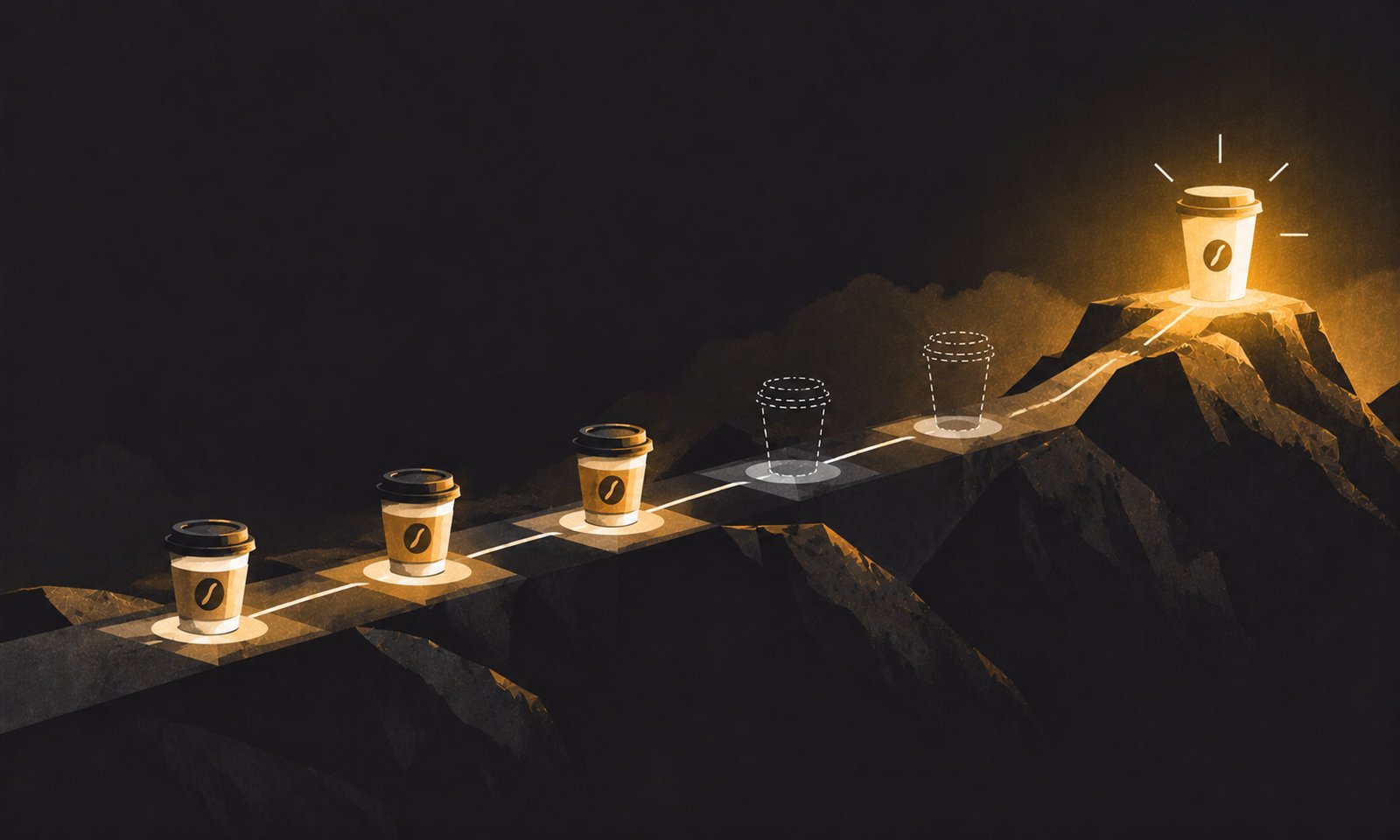
Imagine two coffee cards. One needs ten stamps and you have zero. The other also needs ten stamps, but you already have eight.
Which card makes you want to buy coffee this week?
The second one, obviously. The reward is identical. The coffee is identical. The only thing that changed is how close the finish line feels.
That is the goal gradient effect. Motivation is not fixed. It rises as the gap to the goal shrinks.
2 Where does the goal gradient effect come from?
Clark Hull, 1932. Hull was a behavioural psychologist who put rats in a runway with food at the end. He measured their speed at different points. The rats ran faster the closer they got to the food. He called it the goal gradient hypothesis.
Kivetz, Urminsky and Zheng, 2006. Seventy years later, three researchers tested it on people. They studied a café reward card that gave a free coffee after ten purchases. Customers bought coffee more often as they got closer to the free drink. They published this in the Journal of Marketing Research. They also found something brands often forget: right after people claimed the reward, they slowed down again.
Nunes and Drèze, 2006. This is the study every marketer should know. They gave car wash customers loyalty cards. One group got a card needing eight stamps, starting empty. The other got a card needing ten stamps, with two already stamped. Both groups needed exactly eight more washes. The group with the “head start” card finished far more often. They called it the endowed progress effect.
Put the three together and you get a simple rule. People respond to how far away the goal feels, not how far away it actually is.
3 Why does the goal gradient effect work?
Three things are going on in the buyer’s head.
Small gaps feel doable. “Buy ten coffees” sounds like a project. “Buy two more coffees” sounds like Tuesday. The same goal becomes easier to start when the remaining piece looks small.
Each step feels bigger near the end. Going from eight to nine stamps finishes a big share of what is left. Going from one to two barely moves the needle. Near the finish, every action feels like it counts more.
Unfinished things bother us. A card that is almost full, or a bar that is almost complete, sits in the mind like an open tab. Psychologists link this to the Zeigarnik effect, the tendency to remember unfinished tasks better than finished ones. People want to close the tab.
THE REMAINING GAP RULE
People do not measure progress by what they have done. They measure it by what is left. So design for the gap, not the total.
Rule 1. Show what is left, in one number. “Add ₹80 more” beats “Spend ₹299 for free delivery”. The buyer should never need to do maths.
Rule 2. Never start at zero. Give the first step for free. Pre-stamp the card. Tick “account created” on the checklist. A head start makes the whole goal feel closer.
Rule 3. Plan the moment after the reward. Motivation drops once the goal is reached. Have the next goal ready before the first one is finished.
4 5 goal gradient effect examples you use every week
01. The Blinkit free delivery bar. A thin bar tells you how much more you need to add for free delivery. You add chips you did not plan to buy. The bar makes the gap visible and small, and the goal gradient effect does the rest.
02. Coffee and restaurant stamp cards. The oldest form of loyalty program design. Many cafés now pre-stamp the first box on new cards, which is the endowed progress effect in action.
03. LinkedIn’s profile strength meter. There is no prize for a full bar. People still fill in their profile, because an incomplete bar is annoying to look at.
04. Credit card spend milestones. “Spend ₹12,000 more this quarter to earn bonus points.” Cardholders often shift spending to one card when they are close to the line.
05. Onboarding checklists in apps. “You are 60% done setting up.” Good products show progress early and keep the remaining steps short. This is progress bar psychology used for activation instead of sales.
5 The big mistake: using the goal gradient effect the wrong way
The most common mistake is putting the goal too far away.
If your free delivery threshold is double your average order, nobody feels close. The bar just reminds people they are nowhere near it. Motivation only rises when the goal feels reachable. A far-away goal does not pull people forward. It pushes them out.
Three more mistakes worth knowing:
Starting at zero. An empty bar or blank card makes the whole goal feel like work. The endowed progress effect is free, and most brands leave it on the table.
Forgetting the slump after the reward. Kivetz and his co-authors found people slow down once they claim a reward. If your program has nothing waiting after the first win, you lose them right when they are most engaged.
The middle trap. Later research by Andrea Bonezzi, Miguel Brendl and Matteo De Angelis in 2011 suggested motivation can dip in the middle of a long goal, when the start feels far behind and the end still feels far ahead. Long programs need small milestones in the middle to keep people moving.
A final warning on ethics. A progress bar that honestly shows a real threshold is fine. A bar that fills up and then surprises people with new fees at checkout is not. India’s Central Consumer Protection Authority named several such practices in its 2023 dark patterns guidelines.
6 How to use the goal gradient effect on Monday
- Find every goal you ask customers to reach: free delivery, loyalty tiers, profile setup, onboarding steps.
- Rewrite each one to show the gap, not the total.
- Give a head start on every card, bar and checklist.
- Check that your threshold sits close to your average order or usage, roughly 20 to 30 percent above it.
- Design the next goal before the customer finishes the current one.
- Add small milestones to anything that takes more than a few weeks.
7 Frequently asked questions
What is the goal gradient effect in simple terms?
The goal gradient effect means people try harder the closer they get to a goal. A customer with eight out of ten stamps on a loyalty card is more likely to buy again than one with two stamps, even though the reward is the same.
Who discovered the goal gradient effect?
Psychologist Clark Hull described it in 1932 after watching rats run faster as they neared food. Researchers Ran Kivetz, Oleg Urminsky and Yuhuang Zheng confirmed it in human shoppers in 2006 using café reward cards.
What is the difference between the goal gradient effect and the endowed progress effect?
The goal gradient effect says motivation rises as the goal gets closer. The endowed progress effect, shown by Joseph Nunes and Xavier Drèze in 2006, says that giving people a head start makes them more likely to finish. The first explains the speed-up. The second shows you how to trigger it early.
How is the goal gradient effect used in marketing?
Brands use the goal gradient effect in free delivery bars, loyalty stamp cards, credit card spend milestones, profile completion meters and onboarding checklists. Each one makes the remaining gap visible and small so customers feel pulled toward the finish.
Can the goal gradient effect backfire?
Yes. If the goal is too far away, people give up instead of speeding up. Motivation also drops after a reward is claimed, and it can dip in the middle of long goals. Good design keeps goals reachable and adds new milestones before the old ones end.
Related terms
Endowed Progress Effect · Zeigarnik Effect · Loss Aversion · IKEA Effect · Average Order Value