You’re two years into a marketing job. You’re learning fast. Then a family function happens, and someone asks when you’re writing CAT. That night you open LinkedIn and every brand manager you admire seems to have an IIM on their profile. The doubt sets in.
Summary
You don’t need an MBA for marketing to build a good career. Most marketing skills are learned by doing the work. An MBA mainly buys access: campus placements into large consumer companies, a strong network and a faster route into certain brand management roles. It’s worth it when you need that specific door. It’s often an expensive detour if you simply want to get better at marketing.
Internet Culture · Overthinking Marketing · 003
The belief: “Without an MBA, I’ll hit a ceiling in marketing.”
The honest answer: In some companies, yes. In most of modern marketing, proof of work matters more.
Why this is worth ten minutes
- An MBA for marketing is one of the most expensive career decisions you’ll make, in money and in time.
- The value depends almost entirely on which door you’re trying to open.
- You can figure out the answer for your own path in an afternoon, using LinkedIn and a calculator.
1 The room
Rohan, 25, runs paid campaigns at a D2C brand. He knows CAC, he’s managed real budgets, and he can explain why a campaign failed.
His college friend just got into a top B-school. Rohan’s parents are proud of the friend and quietly worried about Rohan.
He starts researching. Every forum gives him a different answer. “MBA is a must for growth.” “MBA is a waste for marketers.” “Only IIM A, B, C count.” “Just do online courses.”
None of these answers is wrong for someone. None of them knows Rohan’s goal.
2 Do you need an MBA for marketing, or does it depend on the role?
It depends on the role, and the difference is bigger than most people think.
| Where an MBA often matters a lot | Where proof of work usually matters more |
|---|---|
| Brand management at large FMCG and consumer companies, often hired through campus programmes | Performance and growth marketing |
| Marketing leadership tracks in some large, traditional companies | Content, SEO and social media |
| Moving from marketing into consulting or general management | D2C and startup marketing |
| A full career switch where you have no relevant experience | Agency roles, both creative and media |
| Roles in companies that filter CVs by degree | Product marketing in tech companies |
| Freelancing and consulting for small brands |
Large consumer companies have long recruited brand managers through campus placements at top business schools. If that’s your dream path, an MBA is close to the standard entry route.
But much of modern marketing in India runs on a different system. Startups, D2C brands, agencies and tech companies often hire based on what you’ve done. A portfolio of campaigns, a growth number you moved, or a body of writing can matter more than a degree.
3 What does an MBA actually give you?
Be clear about what you’re paying for.
What it gives you:
- Access to campus placements and the companies that recruit there
- A network of classmates who will be in senior roles across industries
- A recognised name on your CV that some filters still look for
- Structured business thinking in finance, operations and strategy
- Time and permission to switch careers
What it doesn’t give you:
- Skill at running real campaigns
- Taste in creative work
- Knowledge of your specific customers
- Experience owning a result with real money at stake
Most of what makes someone a good marketer is in the second list. Most of what an MBA sells is in the first list. Neither is worthless. They’re just different things.
THE DOOR NOT SKILL TEST
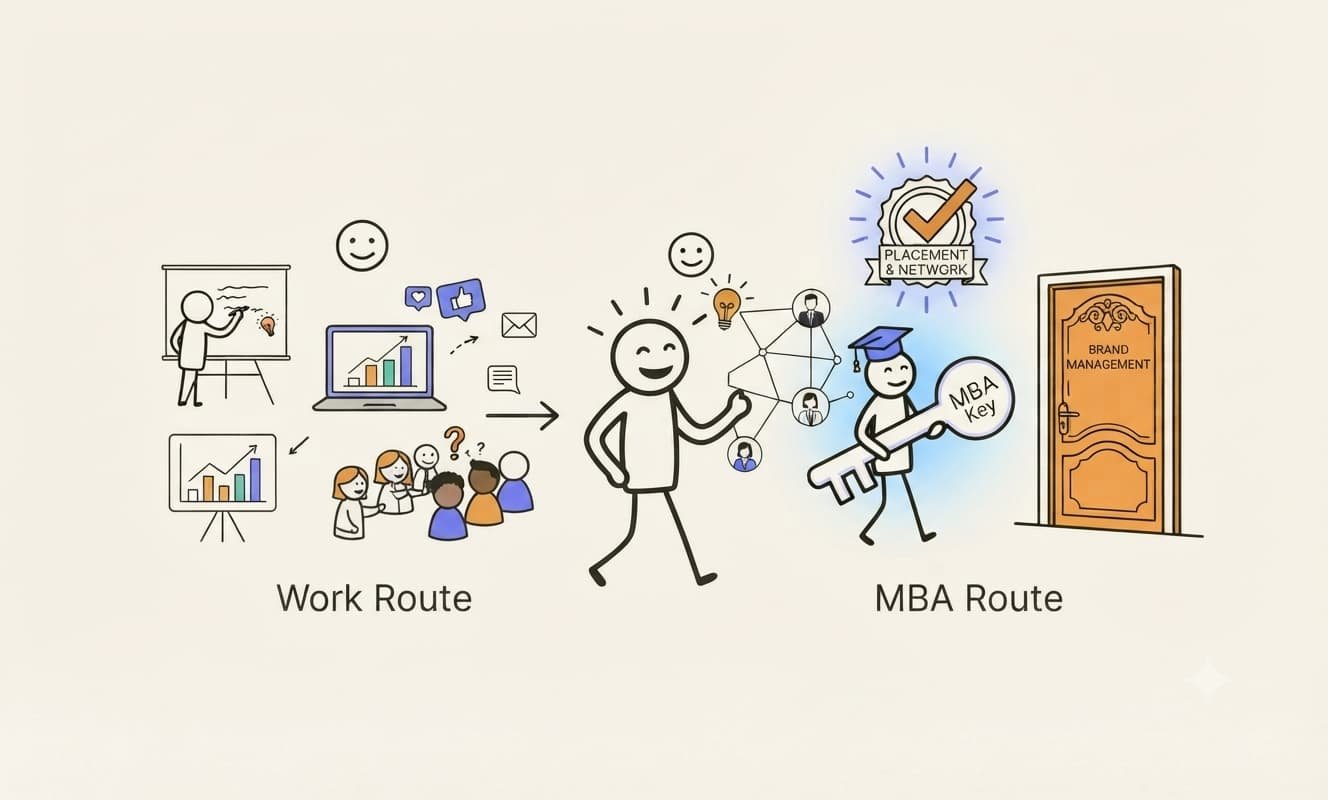
An MBA opens doors. It doesn’t build marketing skill. Pay for it only when there’s a specific door you need, and you can’t open it another way.
Rule 1. Name the door. Write down the exact role and type of company you want in five years. Not “growth”. A real title at a real kind of company.
Rule 2. Check who walks through it. Look at 20 people who have that role today. Count how many have an MBA, and from where.
Rule 3. Price the door honestly. Fees plus the salary you won’t earn for two years. If the door is worth more than that, go. If not, build skill instead.
4 The mechanism stack
01. The real cost is bigger than the fee. People compare course fees. They forget the two years of salary, increments and experience they’re giving up. That missing income is part of the price. For someone already earning well, it can be the bigger part.
02. The college matters a lot. The return from an MBA varies hugely between institutions. Placement access, alumni networks and brand recognition at the very top schools are very different from those at many others. “An MBA” is not one product.
03. Experience changes the value. An MBA after a few years of work, with a clear goal, is a different bet from an MBA straight after graduation with no idea what you want. One-year programmes for experienced professionals are another option worth comparing.
04. Startups hire on proof. In fast-moving companies, a hiring manager often cares more about “show me what you did” than “show me where you studied”. A marketing career without MBA is very normal in these companies.
05. Business thinking is the hidden benefit. The best thing many MBAs teach marketers isn’t marketing. It’s finance and operations. Marketers who understand margins, cash flow and unit economics get taken more seriously in leadership rooms. You can learn much of this without an MBA, but the course forces you to.
5 The counter-weight
Some ceilings are real. In certain large companies, senior brand and marketing leadership roles are still dominated by people with MBAs from top schools. Pretending that filter doesn’t exist would be dishonest.
The network compounds over decades. Your classmates become founders, CMOs and investors. That network can open doors twenty years later in ways a portfolio never will.
It’s a strong reset button. If you’re in an unrelated field and want a clean switch into brand management, an MBA is one of the most reliable routes.
Family and culture matter in India. For some people, the credential carries weight with family, with future employers and with their own confidence. That’s a real factor, even if it doesn’t show up on a spreadsheet.
Skills without credibility can stall too. A brilliant marketer who can’t get past CV filters may struggle to reach the rooms where their skill would show. Sometimes the door is the problem.
Internet Culture verdict desk
An MBA is a key, not a skill. Before you pay for a key, make sure you know which door you’re standing in front of.
6 Steal this
01. Write the five-year role in one line. Title, type of company, city.
02. Find 20 people on LinkedIn who hold that role today. Count their MBAs and note the schools.
03. Calculate the full cost: fees, living costs, and two years of your current salary with expected raises.
04. If you’re not sure yet, build proof while you decide. Own a metric, publish your work, take on a side project. Proof helps whether you do an MBA or not.
05. Learn the business basics now, for free. Understand margins, CAC, payback and retention. These make you sharper with or without a degree.
06. If you do go, go for the door. Spend the two years on placements, networks and the courses you can’t learn at work.
7 Frequently asked questions
Do you need an MBA for marketing?
No. You don’t need an MBA for marketing to build a strong career, especially in performance, growth, content, social, startups, D2C and agencies, where proof of work often matters more. An MBA matters most for brand management roles at large consumer companies that hire through campus placements.
Is an MBA worth it for a marketing career in India?
An MBA is worth it when it opens a specific door you need, such as campus placement into FMCG brand management, and when the school’s placements and network justify the full cost, including two years of lost salary. If you mainly want to get better at marketing, experience and proof of work are usually a cheaper route.
Can I become a brand manager without an MBA?
Yes, especially at startups, D2C brands and mid-sized companies, where people often move into brand roles from content, social, performance or agency work. At large FMCG companies, brand manager roles are more commonly filled through MBA campus hiring.
What should I do instead of an MBA for marketing?
Build proof: own a measurable result, publish your thinking, take on real projects and learn business basics like margins and unit economics. These make you more hireable and also strengthen an MBA application if you decide to do one later.
When is the best time to do an MBA for marketing?
Many people find an MBA more useful after a few years of work, when they have a clear goal and can use the course to switch roles or industries. Doing it without a clear target role makes it harder to get full value from the investment.